Volatiles
Substances that escape as gases during ceramic firing. Many are products of decomposition. For example, calcium carbonate decomposes into CaO and CO₂ gas, losing 44% of its weight. Other common volatiles include water vapour and gases containing carbon, sulphur, fluorine or nitrogen. Their release contributes to loss on ignition (LOI) and can cause glaze defects such as bubbles, pinholes and blisters.
Volatilization is also the process by which substances enter the gas phase and escape during firing. It is not necessarily combustion or decomposition. It can also involve the loss of desirable glaze constituents, such as boron, sodium, potassium or zinc, through the formation and escape of volatile species at high temperatures. Vaporization is a related, more specific term describing the transition from liquid to gas.
| Material or process | Approx. temperature | Volatile |
|---|---|---|
| Physically held water | Below 200°C | Evaporation; not decomposition |
| Organic matter | 200–800°C | Oxidation and gas release; atmosphere-dependent |
| Hydrated lime | 400–500°C | Releases H2O |
| Kaolinite | 450–650°C | Dehydroxylation; releases H2O |
| Calcium carbonate | 650–900°C | Releases CO2 |
| Dolomite | 600–900°C | Decomposes in stages; releases CO2 |
| Certain sulphates | Variable, sometimes above 1000°C | Release sulphur-containing gases |
These are approximate temperature ranges, not fixed decomposition points. Mineral purity, particle size, heating rate, kiln atmosphere and interactions with other materials can significantly change the temperatures at which reactions occur.
Related Information
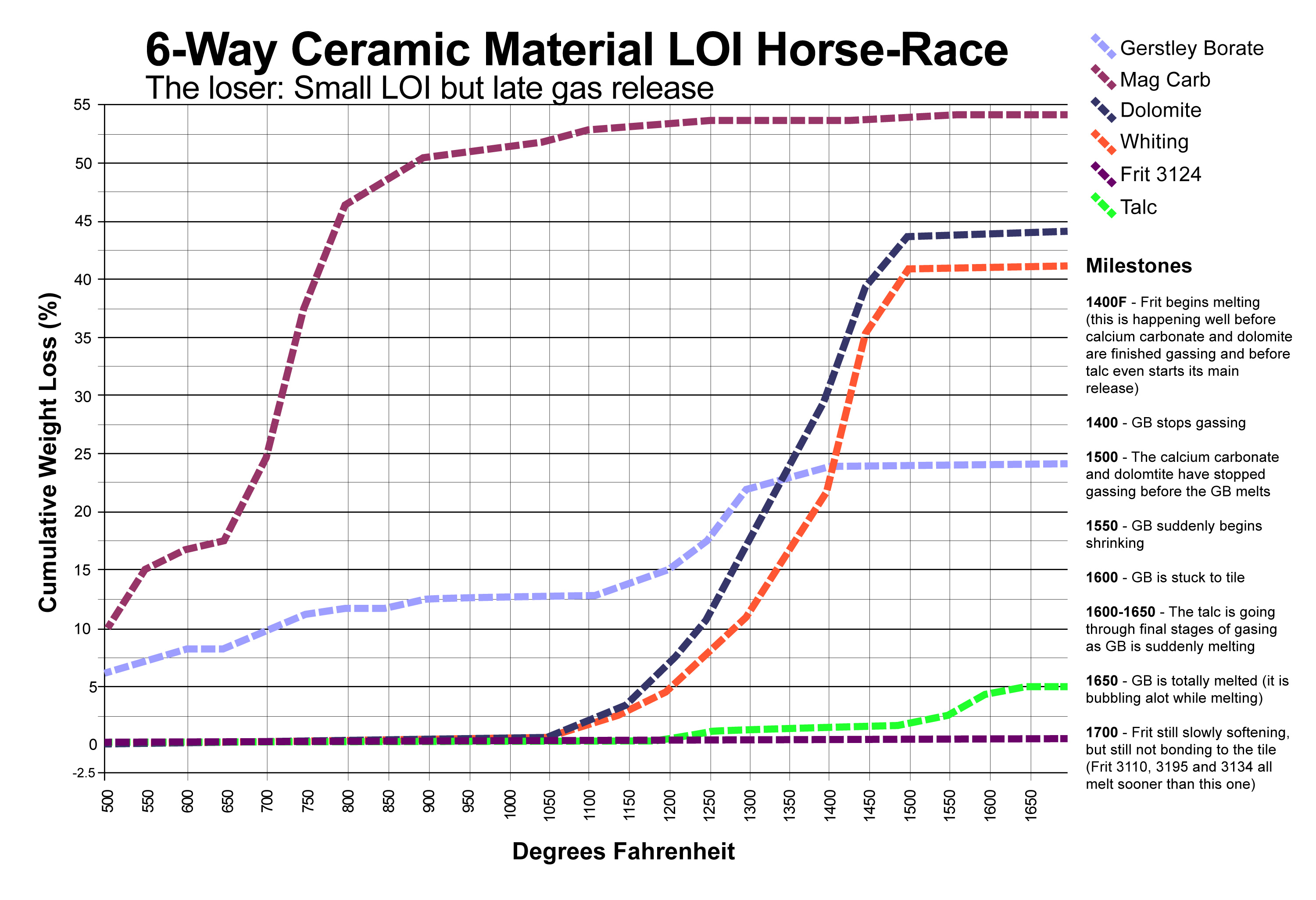
LOI horse race with a surprising winner and loser
This picture has its own page with more detail, click here to see it.
This chart compares the decompositional off-gassing (% weight Loss on Ignition) behavior of six glaze materials (there are many more). Each was heated through the range 500-1700F at 350F/hr. It is amazing how much weight some can lose on firing. For example, 100 grams of calcium carbonate generates 44 grams of CO2! Magnesium carbonate even more. But the main message of this chart is that some late gassers overlap early melters. That can be a problem (causing glaze bubbles, blisters, pinholes). The talc in this test is an example: It did not finish gassing until 1650F. Yet many fritted and Gerstley Borate glazes have already begun melting by then.
There are two takeaways here. The biggest weight loser is not the biggest troublemaker. What matters is how gas release overlaps glaze sealing. Calcium carbonate illustrates this; its high carbonate content can still produce a clear glaze (when gases can clear ahead of any melting). And the talc, although having a small LOI, is a potential troublemaker when the glaze melt cannot effectively clear the bubbles.
Links
| Glossary |
Decomposition During Ceramic Firing
How ceramic raw materials decompose during firing, releasing water, carbon dioxide and other gases that can cause bloating, pinholes and glaze defects. |
| Glossary |
Ceramic Glaze Defects
Ceramic glaze defects include things like pinholes, blisters, crazing, shivering, leaching, crawling, cutlery marking, clouding and color problems. |
 PayPal | No tracking, No ads, No paywall, No transient content! Just organized, concise information constantly updated and improved. Was this helpful? Consider supporting me. |
| By Tony Hansen Follow me on        |  |
Got a Question?
Buy me a coffee and we can talk 

https://digitalfire.com, All Rights Reserved
Privacy Policy