Salt and Soda firing
Salt firing is a process where unglazed ware is fired to high temperatures and salt is introduced to produce a vapor that glazes the ware.
Key phrases linking here: salt and soda firing, salt glazing, salt-glazing, soda firing, salt fired, salt-fired - Learn more
Details

Plainsman P580, P600, H570 soda fired samples
These are standard mullite porcelain bodies designed to fire a little short of full density (or vitrification). They are made using #6 tile kaolin, Tennessee ball clay, nepheline syenite and silica (P580 has no #6 Tile and P600 is 50% #6 Tile). The firing process produces a range of areas having complete glaze coverage to others having no glaze and full flashing.
Many are able to revel in the mystique of the process by simply employing the recipes and procedures of others and using their kilns. But the most successful craftspeople work to understand the chemistry and physics that produce the body and glaze character and the flashing. Of course, most important among these is experience with the kiln and its vapor path, when and how to introduce the salt or soda and how to avoid over or under saturation. However, using the right bodies and developing the right slip recipes is equally important. No conventional glaze is normally needed because the kiln atmosphere itself creates the glaze. That being said, interiors of functional ware may receive a conventional glaze for smoother sealing and better fit.
The salt glazing process has many historical roots. Salt glazed ware typically has distinctive marbled and variegated surface effects - many books showcase these. An increasing number of web pages extol the process and potters pay considerable amounts to attend workshops to learn about it and produce ware. There is, however, a bias toward describing the process in the language of art rather than science. One potter described her preference for the process saying that "the voice of the fire just does not speak to her" in electric-fired ware, with soda firing her ware "says what she wants it to say". And the historic and cultural biases, rather than logic, tend to push the methods and processes used.
Salt glazed ware can be suitable for functional use, but there are caveats. Sodium has the highest thermal example of all common oxides so glazes are almost certain to craze. The impact ware strength and functionality is obvious. Not surprisingly, the oxide formulas of salt glazes fall well outside normal glaze chemistry (a fitted liner glaze on functional pieces is an option some use). Sodium is a very active flux and the salt-glazing process is theoretically feasible for bodies vitrifying at lower temperatures.
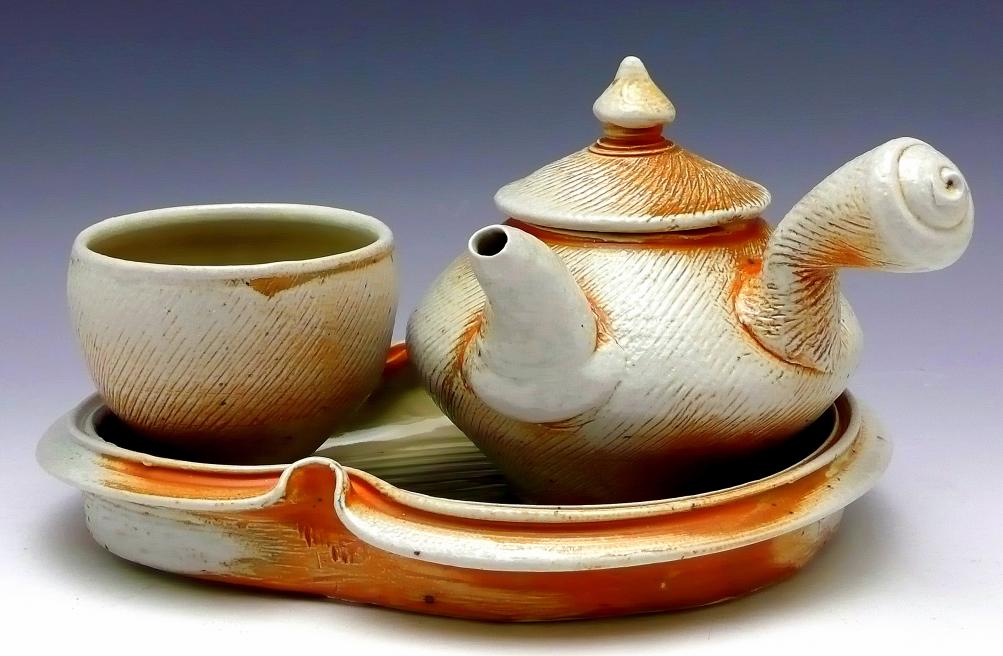
P600 salt fired tea set, with flashing, by Jim Etzkorn
Although salt and soda firing are closely related; the kiln chemistry, surface character, and firing behavior differ enough that experienced potters treat them as two distinct processes. In salt firing, common salt (NaCl) decomposes releasing sodium as flux and chlorine as gas. In soda firing sodium carbonate (or bicarbonate) release sodium more rapidly (but without chlorine). Salt is more aggressive, its vapor penetrates strongly (especially to interiors), surfaces glaze more readily (to classic thicker, glossier orange-peel texture). However, kiln walls suffer more attack, and burners and refractories deteriorate faster with salt. Soda is thus better for localized effects and selective flashing. It produces softer surfaces, more variation, better flashing and subtler oranges, reds, yellows, greys.
Related Information
Salt glazed pieces often craze

This picture has its own page with more detail, click here to see it.
Crazing in glazes is common in this type of ware but since the body is fired well into vitrification this is not considered a problem (the unique aesthetics of this type of ware trump such issues). Salt glazes, by their very nature, are high in sodium. Since Na2O has such high thermal expansion pieces are almost guaranteed to craze. This was from kiln at the Medalta artist in residence program
Plainsman P580, P600, H570 soda fired samples

This picture has its own page with more detail, click here to see it.
These are standard mullite porcelain bodies designed to fire a little short of full density (or vitrification). They are made using #6 tile kaolin, Tennessee ball clay, nepheline syenite and silica (P580 has no #6 Tile and P600 is 50% #6 Tile). The firing process produces a range of areas having complete glaze coverage to others having no glaze and full flashing.
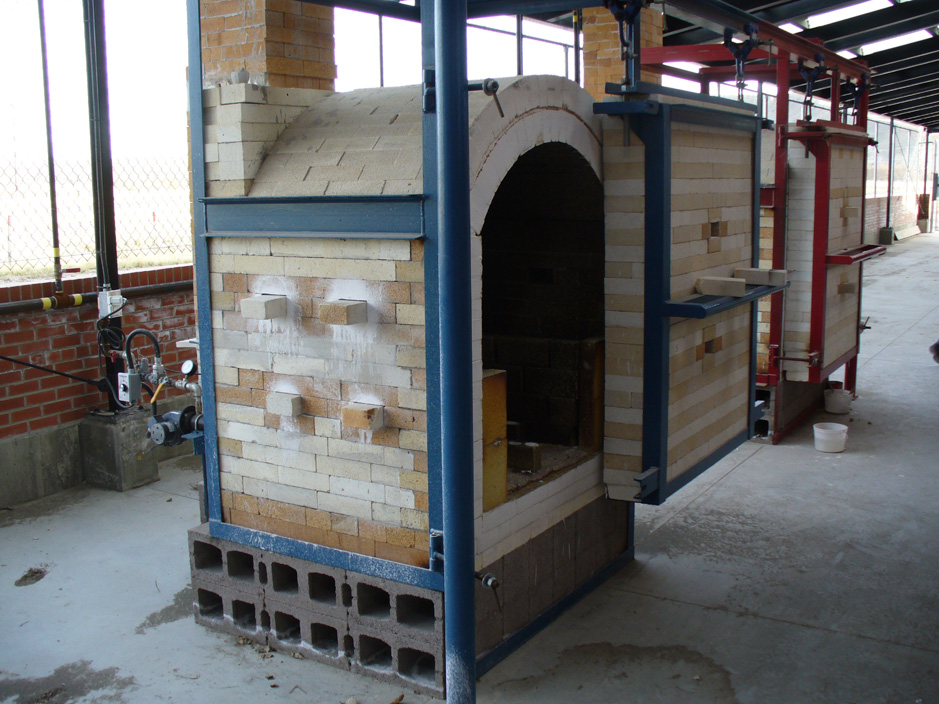
Front of soda and salt kilns
At the Medalta International Artists in Residence
This picture has its own page with more detail, click here to see it.
In Medicine Hat, Alberta, Canada. Designed by Aaron Nelson.
Rear of soda and salt kilns
At the Medalta International Artists in Residence

This picture has its own page with more detail, click here to see it.
In Medicine Hat, Alberta, Canada. Designed by Aaron Nelson.
A studio salt kiln being unloaded

This picture has its own page with more detail, click here to see it.
Notice how ware is set on pads of clay to enable the salt vapours to access the underside. Salt and soda kilns degrade over time as the sodium eats away at the interior bricks. Shelves must be covered in kiln wash to preserve them.
Salt glaze beehive kiln beside the Plainsman Clays plant

This picture has its own page with more detail, click here to see it.
This was built just after the turn of the 20th century and was one of about 20 at the Alberta Clay Products company. It was used to fire salt-glazed ceramic pipe, these were used for municipal sewer and water lines. A ceramic industry quickly grew in the city because it had good clay, natural gas, plenty of water, a dry climate, industrious people, a large river and it was on the Trans Canada highway and railway.
A salt glazed sewer pipe junction

This picture has its own page with more detail, click here to see it.
Made at Alberta Clay Products in Alberta, Canada about 1960. These are massive. They were hand-constructed. This was fired in a beehive kiln and is on display inside one next to the Plainsman Clays plant (a historic site). Ceramic glazes are normally slurries of clay, quartz and and fluxes like sodium feldspar, calcium carbonate or dolomite - these are applied to ware before firing. But, in this salt-glazing process, common table salt was literally shovelled into a hole at the top as the kiln reached temperature (about 2350F)! The salt decomposed, separating into sodium vapour and chlorine gas within the chamber and the sodium reacted with the quartz-containing clay to form a durable glaze. Unfortunately the chlorine gas escaped into the air!
Salt fired P700 by Jim Etzkorn

This picture has its own page with more detail, click here to see it.
P700 salt fired copper glazed plate by Jim Etzkorn
Links
| Glossary |
Kiln Firing
All types of ceramic are fired in a kiln to cement particles together to produce a hard and water and temperature resistant product. |
| Glossary |
Flashing
A visual effect that occurs in wood and salt firing of ceramic ware. Many potters value the effect and use special materials and firing methods to enhance it. |
 PayPal | No tracking, No ads, No paywall, No transient content! Just organized, concise information constantly updated and improved. Was this helpful? Consider supporting me. |
| By Tony Hansen Follow me on        |  |
Got a Question?
Buy me a coffee and we can talk 

https://digitalfire.com, All Rights Reserved
Privacy Policy