Glaze laydown
Refers to the quality of the dried ceramic glaze layer and how this affects the fired result: e.g. density, hardness, evenness, thickness, freedom from defects, etc.
Key phrases linking here: glaze laydown, laydowns, laydown - Learn more
Details
In industrial ceramics, the quality of the dried glaze layer, or laydown, is an important part of process control. The objective is a layer of controlled thickness that is even, dense, well bonded and free of cracks, pinholes, crawling precursors and other discontinuities. Industrial glaze slurries, application equipment and drying systems are highly tuned to achieve this. For many manufactured ceramic products, even a single glaze defect can reject an entire item for recycling, refiring or discard.
Potters tend to give glaze laydown much less attention. Since the glaze will melt, there is a natural assumption that irregularities in the dried layer will simply heal during firing. To some extent they do. But a glaze melt can only redistribute material that is present, and it has limited time and fluidity with which to do so. A defect already present in the dried layer can become the starting point for a crawl, pinhole, blister, bare spot or thickness variation in the fired glaze.
Many factors affect laydown quality. A smooth porcelain surface is generally easier to coat evenly than a coarse or heavily grogged body. Moderate, controlled glaze thickness is easier to dry without cracking than an excessively thick layer. A well-suspended, thixotropic dipping slurry can deposit a surprisingly dense and even layer, whereas a poorly suspended one may drain unevenly, settle rapidly or produce thickness variations. Drying should be reasonably quick and uniform, but not so rapid that shrinkage stresses crack or detach the coating.
Glaze recipe and slurry preparation are equally important. Adequate fine clay particles improve suspension, adhesion and cohesion of the dried layer. Recipes having little or no clay can produce fragile, powdery or poorly bonded coatings unless compensated for by gums, binders or other additives. Particle-size distribution also matters: a well-designed mixture of particle sizes can pack more densely and produce a more coherent layer than one dominated by coarse particles.
Gummed slurries can produce excellent laydown because the binder improves adhesion and dry strength. However, they retain water and penetrate porous bisque more slowly, so dipping application can become difficult. Achieving a dense, even layer that dries reasonably quickly requires control of slurry rheology, specific gravity, application and drying. Slow drying on porous bisque can introduce its own problems.
Commercial brushing glazes might appear disadvantaged because brush marks and overlapping strokes make the wet coating visibly uneven. However, their low specific gravity, gum content and requirement for multiple coats work together: successive layers fill and level irregularities and make it possible to build the desired thickness gradually. Brushing also permits deliberate variation of thickness on specific areas of an object.
Spraying likewise has the potential to produce very high-quality laydown. With suitable slurry properties, spray equipment and operator technique, glaze can be deposited gradually and uniformly, even on complex shapes. But poor atomization, excessive overspray, application to an overly dry surface or failure to build sufficient wet cohesion can produce a porous or powdery layer rather than a dense one.
Glaze defects such as crawling, pinholing and unhealed blisters often send potters looking for another recipe. Industry is more likely to regard the glaze recipe as only one part of the system. The slurry rheology, particle-size distribution, additives, application thickness, body surface, bisque condition and drying process are all potential causes. Improving the dried glaze laydown can sometimes solve a fired glaze defect without changing the glaze chemistry at all.
Related Information
When glaze laydown is not even …
The fired surface likely won’t be either

This picture has its own page with more detail, click here to see it.
Dried glaze layer on a lightly grogged middle temperature stoneware (Plainsman M325). Notice how the bubbling that occurs during the drying of the glaze has disrupted the laydown. This is a glossy transparent and will likely level out, but if it were a matte or glaze having a stiffer melt, this texture would be evident in the fired piece.
Crawling on sanitary ware:
Laydown is the first suspect

This picture has its own page with more detail, click here to see it.
This is glaze crawling and it underscores the need for attention to the details of all production parameters. This one small glaze defect makes this pedestal sink either a refire, a second or unsaleable. This is most common on abrupt surface contours but that is not the case here. The cause of this is likely several factors combining. The glaze is opaque white because it contains a high percentage of zircon opacifier. Zircon glazes tend to do exactly this so their successful use is doubly dependent on minimizing the percentage added and on attention to other details to compensate. This glaze has been applied thickly to ensure good coverage (thicker laydowns bring more crawling problems). The glaze is likely low in clay and thus the physical bond of the dried glaze layer depends on the binders being used, their percentages, the integrity of the way they were mixed in, and their shelf life. The ability of the glaze laydown to dry-bond with the body depends on the condition of the surface (e.g. water content, dry or bisque fired, smoothness, dustfreeness, quality of materials used in the body and integrity of body preparation, etc), the presence of surface contaminants (e.g. soluble salts) and the way in which it was applied and its thickness. The glaze melt's ability fire-bond and form an interface with the body that produces a smooth surface is dependent on its melt fluidity and ability to form an interface with the body.
There is another way to look at this problem: The process runs along crawling multiple tipping points: A viscous glaze melt, glaze application to dry rather than bisque ware, a thick glaze application, a large surface area intolerant of any defects and a glaze application technique (spraying) prone to irregularities of thickness. Rather than trying to identify the specific problem it might be better to simply make changes to move the process back from the tipping points.
Gummed dipping glazes can dry like this:
How to fix it.

This picture has its own page with more detail, click here to see it.
Gummed glazes dry slowly and on porous, dry bisque this often happens. The one on the top left was dipped for three seconds, and the ones on the top right and bottom right for five seconds. Thus, the thicker the application the worse this is. A complicating factor is that this is a base-coat dipping glaze, it has enough gum to slow down drying significantly, providing plenty of time for escaping air, displaced by the water being absorbed, to create these holes. If these tiles were much thinner the problem would obviously be much less. But the thickness also enables a simple solution: The bottom left tile was dipped into water first. An extra benefit of the water is that the glaze penetrates into recesses in the surface better.
Unwanted streaking in a glaze:
Uneven laydown is the likely reason
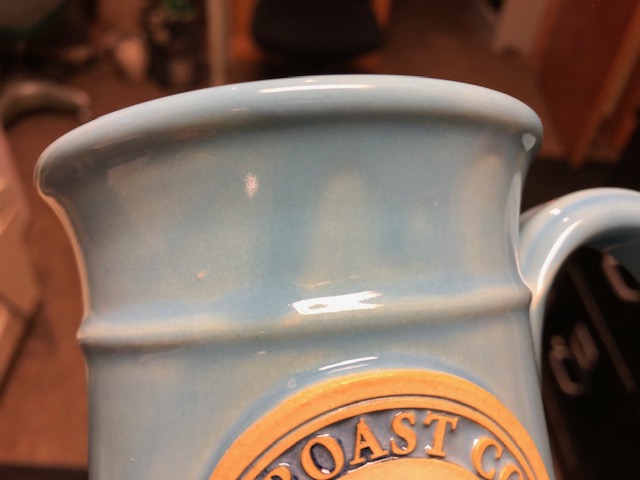
This picture has its own page with more detail, click here to see it.
This is a fluid melt cone 6 glaze with colorant added and partially opacified. It runs into contours during firing, thickening there (notice the darkening around the logo), this is a desired visual effect. However, notice that drips and runs coming down from the rim, they are producing darker streaks. This is a laydown issue. Dipping glazes that fasten-in-place too slowly will often drain unevenly on extraction from the bucket. This can be solved by making slurries thixotropic. Even on dense bisque, they will fix-in-place in an even layer. Glazes having sufficient clay (e.g. 15% kaolin) will gel more easily (to become thixotropic). Slurries containing significant CMC gum may apply evenly but thinly (and dry slowly, with drips).
Bad and good glaze laydown:
The difference was the rheology.

This picture has its own page with more detail, click here to see it.
This is GR6-L, is the standard GR6-A Ravenscrag Slip cone 6 base recipe + 10% chrome tin stain (the body is Midstone, the inside glaze is G2926B, the firing schedule is C6DHSC). The mug on the left has an issue. The glaze has gone on in thicker, but also in varying thicknesses. Highlighting of the incised design has been drowned in variegation.
The problem was the rheology. The specific gravity was too high, even on a quick dip it built thickness unevenly and way too fast. And there were drips that were so big they had to be shaved off with a knife! After the addition of a lot of water, to take the specific gravity from 1.55 to 1.45 it was watery enough to accept some Epsom salts to make it thixotropic. The difference was amazing, it went on totally smooth without a single drip, producing the result on the right.
Engobes can enable more even glaze laydown

This picture has its own page with more detail, click here to see it.
This stoneware jar is made from a large particle size body with grog added. It was engobed on the inside and over the lip at the leather hard stage and bisque fired. Now it has been dip-glazed inside and out. Because the clay is so porous, lots of air must escape from inside the wall as the matrix soaks up water from the freshly applied glaze. But the air is being channeled into pathways and concentrated into surface irregularities created by the coarse particles (especially on incised lines). At each of the escape sites a bubble appeared (then healed into a depression when it burst). But the engobe on the inside creates a homogeneous surface that distributes air escape uniformly, a more even laydown in the result.
High-titanium glazes:
Great on a test tile, troublesome on ware

This picture has its own page with more detail, click here to see it.
On this M390 red clay test tile, the titanium-variegated cone 6 calcia matte glaze G1214Z1 looks excellent (rutile has a similar effect). But that appearance depends on a combination of factors: glaze chemistry, 5% titanium dioxide, the titanium grade, application thickness, the red M390 body and the PLC6DS firing schedule. The relief of the tile especially flatters it - forcing the glaze thin over high points and allowing it to pool in recesses, displaying a whole range of effects in just a few centimetres.
The tile tells you what effects a glaze is capable of; it does not necessarily tell you what the glaze will look like on ware. These mugs demonstrate that. They were fired using the C6DHSC schedule and are made from buff-burning M340 (left) and M390. The mug on the right also has a heavier, less-even application. Surprisingly, some of the thickest runs become more transparent rather than more opaque. That is a reminder that the pale, variegated character of this glaze is not simply the result of titanium acting as an opacifier; it depends heavily on melt thickness and titanium-driven crystallization during cooling.
 PayPal | No tracking, No ads, No paywall, No transient content! Just organized, concise information constantly updated and improved. Was this helpful? Consider supporting me. |
| By Tony Hansen Follow me on        |  |
Got a Question?
Buy me a coffee and we can talk 

https://digitalfire.com, All Rights Reserved
Privacy Policy