Bone China
A ceramic whose priorities are translucency, whiteness, fired strength and resistance to thermal shock failure.
Key phrases linking here: anorthite porcelains, anorthite porcelain, bone china - Learn more
Details

Although this mug is made using regular pottery porcelain having some translucency, it cannot compare to real bone china.
Bone ash is used (today available in synthetic form as tri-calcium phosphate). A typical recipe is 50% bone ash, 25% Cornwall Stone (or feldspar) and 25% kaolin. As noted, tuning a firing curve and executing it consistently is a key to ware quality. Quality also hinges on the materials, especially the kaolin, it needs to be low in iron (for whiteness) and low in titanium (for translucency). With only 25% kaolin, the bodies have extremely low plasticity, which limits manufacturing methods (casting is most suitable). As a plastic material, it can only be formed in controlled industrial contexts (e.g. jiggering, jollying).
The glazing process is completely different than what a potter would do: Bisque fire to maximum density, glaze, high fire. Bone china is bisque-fired to high fire and then glazed at a lower temperature. Since the porcelain has zero porosity, typical potters would balk at the process needed to get a glaze to stick and dry on the bisque ware. And they would be surprised at how thin a layer is needed.
Why don't they use calcium carbonate to source the CaO? Because of its high LOI. Calcined bone ash produces no gas and it introduces CaO into the system at the right time and over time so that it reacts more gradually and distributes Ca more uniformly. Bone ash also introduces P₂O₅, which enters the glass phase, modifying viscosity, enhancing crystallization, aiding translucency and altering thermal expansion subtly.
How do they fit glazes on a body that has no silica? Bone china is a phosphate glass ceramic; its thermal expansion is well within the reach of borosilicate glazes.
How do they keep the thin pieces from warping during bisque firing? Custom-made setters for each piece.
Why don't pieces warp in the glaze firing, which may only be 100C lower? The ceramic created in the bisquit firing has surprising rigidity upon refire because the glass phase was already developed and remains stable.
Why did they use lead glazes? First, lead silicate was used (up to 60% PbO), but industry switched to lead borosilicate. Compared to simple borosilicates used in traditional ceramics, they melt lower, flow better, and produce superior optical qualities. They gave a "wet surface" appearance, with brighter gloss, greater depth, and enhanced brilliance. They also increased surface tension control and levelling, and reduced pinholing and minor surface defects. Modern alkali-borosilicate and zinc-borosilicate systems are much less forgiving and less appealing visually. They rely on B2O3 for low melt, KNaO adjustments for fit, ZnO for gloss and melt behavior, and careful silica/alumina balance.
Why is bone china so translucent? The best ceramic achieved has very fine and evenly dispersed crystals and outstanding density (no pores to scatter light). The refractive indices between the glass and crystal phases are also very similar, further preventing light scattering. These factors also combine to achieve high strength and thermal shock resistance.
So-called "fine china" is a marketing term that can refer to bone china, but most often to mullite porcelain (which can be fired much hotter).
The strength, translucency and the process needed to make bone china, are likely well beyond your capability as a potter or hobbyist. Consider other ways to achieve white-porcelain-translucency using more humble materials and firing. Modern controller-equipped kilns enable precise firing, so all manner of mullite porcelains and even fritware are at your disposal. It is even possible to make porcelain-like ceramic down to cone 06 using frit additions (e.g. Zero4 porcelain). This being said, bone china is still within the reach of determined people with studio kilns and a willingness to do a testing program to optimize the body, glaze and process. It will be about data, consider collecting and analyzing it in an account at insight-live.com.
Related Information
Now that is a translucent porcelain! But much more.

This picture has its own page with more detail, click here to see it.
These are two cone 6 transparent-glazed porcelain mugs. On the left is the porcelainous Plainsman M370 (Laguna B-Mix 6 would have similar opacity - none). Right is the highly vitreous, New Zealand kaolin-based porcelain, Polar Ice. The secret to making this porcelain super-white is the NZ kaolin. The secret of its impossibly high plasticity is the very expensive plasticizer, VeeGum T. What about the translucency? That is a little more complicated. Nepheline syenite is used as the feldspar, but it alone, in a practical recipe, cannot deliver this kind of translucency at cone 6. Amazingly, the 4% Veegum acts as a translucency catalyst; it is the real secret. Commercial manufacturers could never use a sticky and difficult-to-dry porcelain like this, but a potter can do incredible things with it (e.g. throw thinner, lighter, bigger than any other clay he/she has ever used!). Can you make this? Yes. Try the L3778D or L3778G recipes.
A Lithophane exploits porcelain translucency to reveal its design

This picture has its own page with more detail, click here to see it.
Top: A thin porcelain tile with etched design. Bottom: The same tile with a back light. By Stephanie Osser. L3778G is an example of a translucent mullite porcelain that will work for this.
Zero3 casting porcelain at cone 04, 03
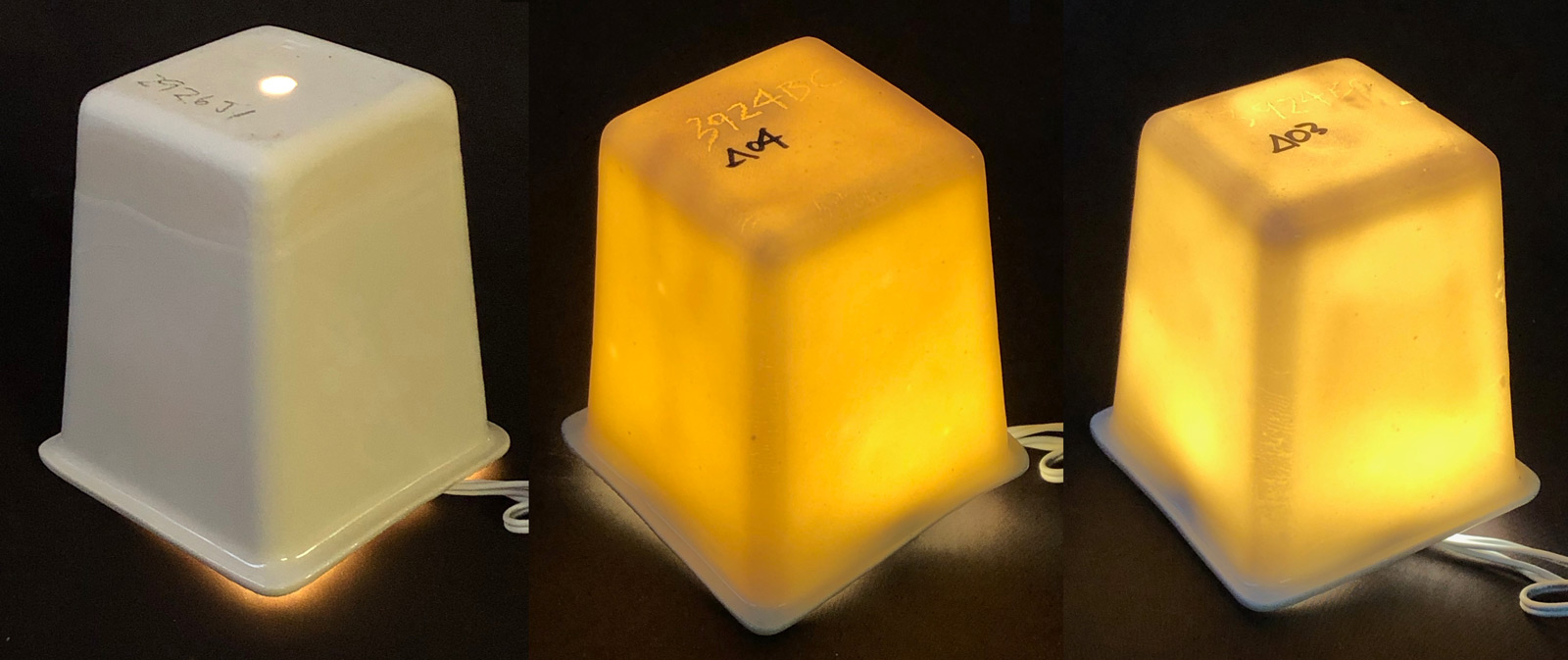
This picture has its own page with more detail, click here to see it.
Compared to a typical cone 6 porcelain, left, which has zero translucency, these are fired 10 cones lower. I am using the G3879 clear glaze and it is working very well.
Mullite and anorthite porcelains:
The microstructure was only understood recently
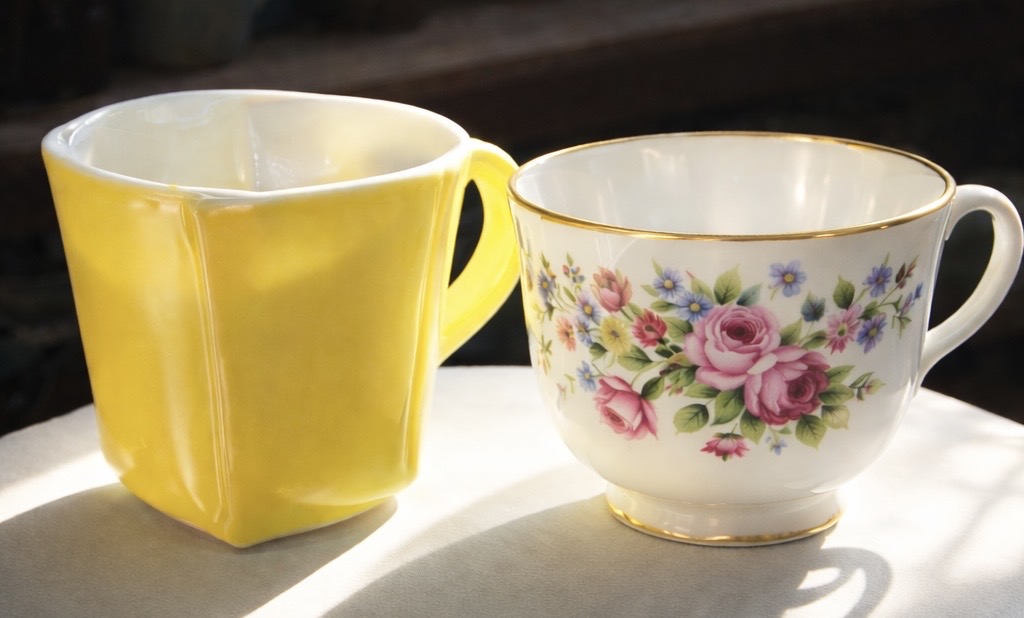 Produced by Gemini, combining a picture of a mug I made with a generated bone china one. AI Policy
This picture has its own page with more detail, click here to see it.
The porcelains that potters and traditional industry (sanitaryware, electrical insulators, common tableware) know and love are actually "mullite porcelains", named such because the fundamental source of strength (both fired and pyroplastic) is the needle-shaped mullite crystals that grow during the final stages of firing. The mug on the left is fired at 2200F and is made of high-feldspar Polar Ice. The kaolin crystals converted to mullite rather than dissolving in the feldspar glass.
Bone china, by contrast, is a calcium aluminosilicate glass-ceramic. It is "anorthite porcelain", relying on calcium from bone ash reacting with SiO2 and Al2O3 (from the kaolin and feldspar) to form anorthite crystals. The reward is strength and translucency (without brittleness), having fine and evenly dispersed crystals and outstanding density (no pores to scatter light). The refractive indices between the glass and crystal phases are also very similar, further preventing light scattering.
Both of these crystal types can be found in nature. But here, they are grown spontaneously during firing. Gradual recognition of these mechanisms was two centuries in the making, but not clear until the 1960s-1980s! Anorthite system mapping being the latter. Understanding and relationships with thermal expansion and translucency and kinetic control in fast-fire kilns has happened since then.
Inbound Photo Links
 Bone China Anti-Warp Setter test molds |
Links
| URLs |
http://home.howstuffworks.com/lenox.htm#
What is bone china and how is it made at howstuffworks.com |
| URLs |
https://www.instagram.com/reel/DZXXBa_iIdG
Studio slip-casting bone china mugs at https://www.repeatrepeat.co.uk in Stoke-On-Trent Very interesting way to quickly cut handles to fit and the use of one-piece molds. |
| Glossary |
Plasticity
Plasticity (in ceramics) is a property exhibited by soft clay. Force exerted effects a change in shape and the clay exhibits no tendency to return to the old shape. Elasticity is the opposite. |
| Glossary |
Terra Cotta
A type of red firing pottery. Terra cotta clay is available almost everywhere, it is fired at low temperatures. But quality is deceptively difficult to achieve. |
| Glossary |
Stoneware
To potters, stonewares are simply high temperature, non-white bodies fired to sufficient density to make functional ware that is strong and durable. |
| Glossary |
Vitrification
A process that happens in a kiln, the heat and atmosphere mature and develop the clay body until it reaches a density sufficient to impart the level of strength and durability required for the intended purpose. Most often this state is reached near zero p |
| Glossary |
Translucency
A highly sought-after property in porcelain, fired close enough to melting to take on the glass-like property of passing light. Translucency implies tendency to warp during firing. |
| Glossary |
Fritware
A porcelain with significant added frit. The frit matures it at a far lower temperature than typical. The strength mechanism is one of particle glass bonding rather than mullite development. |
| Materials |
Bone Ash
|
 PayPal | No tracking, No ads, No paywall, No transient content! Just organized, concise information constantly updated and improved. Was this helpful? Consider supporting me. |
| By Tony Hansen Follow me on        |  |
Got a Question?
Buy me a coffee and we can talk 

https://digitalfire.com, All Rights Reserved
Privacy Policy