Casting Rate
Casting rate describes how quickly a layer of clay builds against the mold surface during slip casting.
Key phrases linking here: casting rate - Learn more
Details
Casting rate describes how quickly a layer of clay builds against the mold surface during slip casting. In conventional plaster molds, capillary suction draws water from the slip, leaving a consolidated layer of particles behind. Water must then pass through this layer for more material to deposit. As the wall thickens, resistance to water movement increases and further buildup slows. Thus, twice the casting time does not produce twice the wall thickness. For practical comparisons, casting rate can be assessed by measuring the thickness produced in a fixed time or the time needed to reach a specified thickness.
Casting rate depends strongly on the permeability of the deposited layer. While influenced by particle size distribution, particle packing and the degree of deflocculation, the main factor is the nature of the clays used, especially their plasticity. Very fine plastic clays can provide excellent strength but form layers through which water moves slowly. Larger-particle clays, which are less plastic, can build thickness much faster. However, speed alone is not the objective: The cast must also develop enough strength and drying shrinkage to pull itself away from the mold as it shrinks. The formulation challenge is to obtain sufficient strength and reliable release while retaining good permeability.
Casting rate is a property of the slip-and-mold combination, not simply of the body recipe. A wet mold will obviously cast more slowly than a dry one. Ware shape and surface detail also affect casting time. A testing program should therefore record wall-building time, release time and the quality of the resulting ware under comparable conditions.
Related Information
Demonstrate casting-rate control:
By slip-casting nepheline syenite

This picture has its own page with more detail, click here to see it.
What would it take to cast pure Nepheline Syenite? A clay addition. This 10:90 bentonite:Nepheline has enough shrinkage and leather-hard strength to enable pulling itself away from the plaster mold. This bowl was just extracted; it cast without cracks to 3mm thickness in about 15 minutes. The defloculated slip required more water than normal but it pours and drains really well. This is a demonstration of how much control technicians can have over casting rate. The amount and type of plastic clay added can take this material from being completely water permeable, zero leather-hard strength and non-castable to water impermeable, very high leather-hardness but very slow casting. Only a testing program is needed to determine the minimum bentonite percentage needed to achieve reliable casting (it is likely less than 10%).
For example, 95%+ nepheline slurries can be made using Veegum. How did this bowl fire? As a vitreous product around cone 1. And, on aging for a month, the rheological properties of the slurry did not change.
NZ kaolin-based slip casts at 1mm thickness. How?
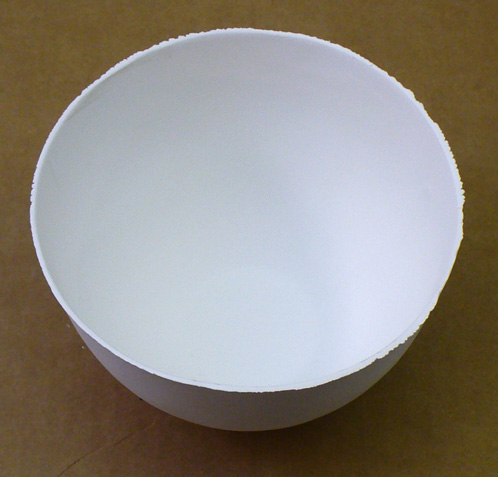
This picture has its own page with more detail, click here to see it.
This is Polar Ice casting, a cone 6 translucent porcelain that uses New Zealand Halloysite. The base body recipe would never have enough plastic strength to pull itself from this mold without tearing. But the addition of 1% Veegum gives it amazing strength. This dried cast bowl measures 130mm in diameter and 85mm deep; it only weighs 89 gm! The slip was in the mold for only 1 minute before pour-out. Of course, there is a price to pay for adding the Veegum: Increased casting time and more difficult deflocculation. This 1% addition can be refined. A program of testing could indicate that a lower percentage of Veegum could work, increasing the casting rate. The polar ice information page has very good information, under the heading “Casting Recipe” (it deals with the trade-offs of using this kaolin in casting bodies).
This Cone 6 Porcelain Casts Super-Fast
The type of kaolin and ball clay is the secret

This picture has its own page with more detail, click here to see it.
Rather than L4807 being just another cone 6 porcelain casting slip recipe it is a pattern of the flexibility potters/hobbyists could have in making their own bodies. This has incredible casting speed. If someone tells you that porcelains are always difficult to cast, tell them it’s time to go DIY.
Typical slips made from ball clay and talc (or mixes of common feldspars, clays and quartz) take 20-30 minutes to get the needed thickness (in our circumstances and assuming a new dry mold). But this one poured out in 12 minutes and I can demold in 10 minutes. The secret is not the recipe, this is similar to a typical 25-porcelain. The secret here is choice of kaolin and ball clay. This employs OptiKast Kaolin and KT#1-4 ball clay, both are large particled clays targeted at slip casting. They can be traded off for each other, more ball clay imparts better leather-hard strength but casts slower, more kaolin does the opposite. This is one more reason to mix your own casting bodies.
How a kaolin and ball clay compare in a dry performance test
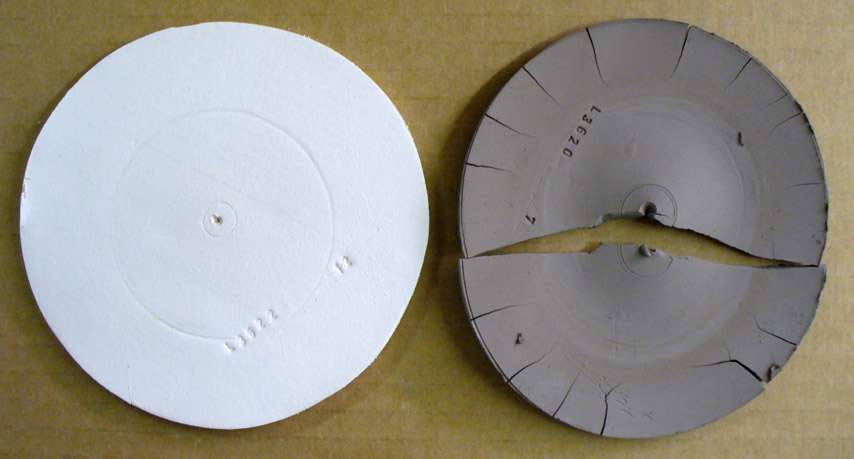
This picture has its own page with more detail, click here to see it.
These are DFAC drying performance disks of a large-particle kaolin (OptiKast) and a ball clay (Plainsman A2). This test reveals a clay's response to uneven drying (these disks are dried with the center portion covered). The kaolin feels smoother yet its ultimate particles are ten to one hundred times bigger than a typical ball clay. Thus it shrinks much less. The ball clay has dramatically lower water permeability, water from the center protected portion resists migration to the outer edge during drying. When the inner section finally dried the outer was already rigid so it split the disk in two and pulled all the edge cracks. Most ball clays shrink more and crack worse than this (cracks concentric to the center also appear). So why use ball clay? This kaolin is so lacking in plasticity it was barely possible to even make this disk. And it is so weak that it can easily break just by handling it. Still, it is useful to make casting bodies. But the ball clay, when used as a percentage of a body mix, can produce highly plastic bodies than can be dried without trouble if done evenly.
 PayPal | No tracking, No ads, No paywall, No transient content! Just organized, concise information constantly updated and improved. Was this helpful? Consider supporting me. |
| By Tony Hansen Follow me on        |  |
Got a Question?
Buy me a coffee and we can talk 

https://digitalfire.com, All Rights Reserved
Privacy Policy