Case Mold
A case mold is used to make working molds, most often for slip casting in ceramics. These are now commonly for sale online (to potters and hobbyists) as 3D-printed forms into which plaster is poured to make a production mold. We advocate learning to use 3D CAD software and making your own case molds using a consumer 3D printer and PLA filament. Or going to the next level and printing block molds for the production of rubber case molds. Following is clarification of trandtional terminology:
- Model: The positive master shape scaled up to account for clay and firing shrinkage. Most often carved from plaster.
- Block mold: The first negative mold made directly from the model. It is kept safely in storage (and archived if a design is discontinued).
- Case mold: A mold of a working mold. Case molds are cast from a block mold. In the past they were typically made using plaster but more recently using rubber. A case mold can be used to pull multiple identical production molds.
- Working or production mold: Made from the case mold. Used to cast the actual clay pieces. Almost always made using pottery plaster.
Related Information
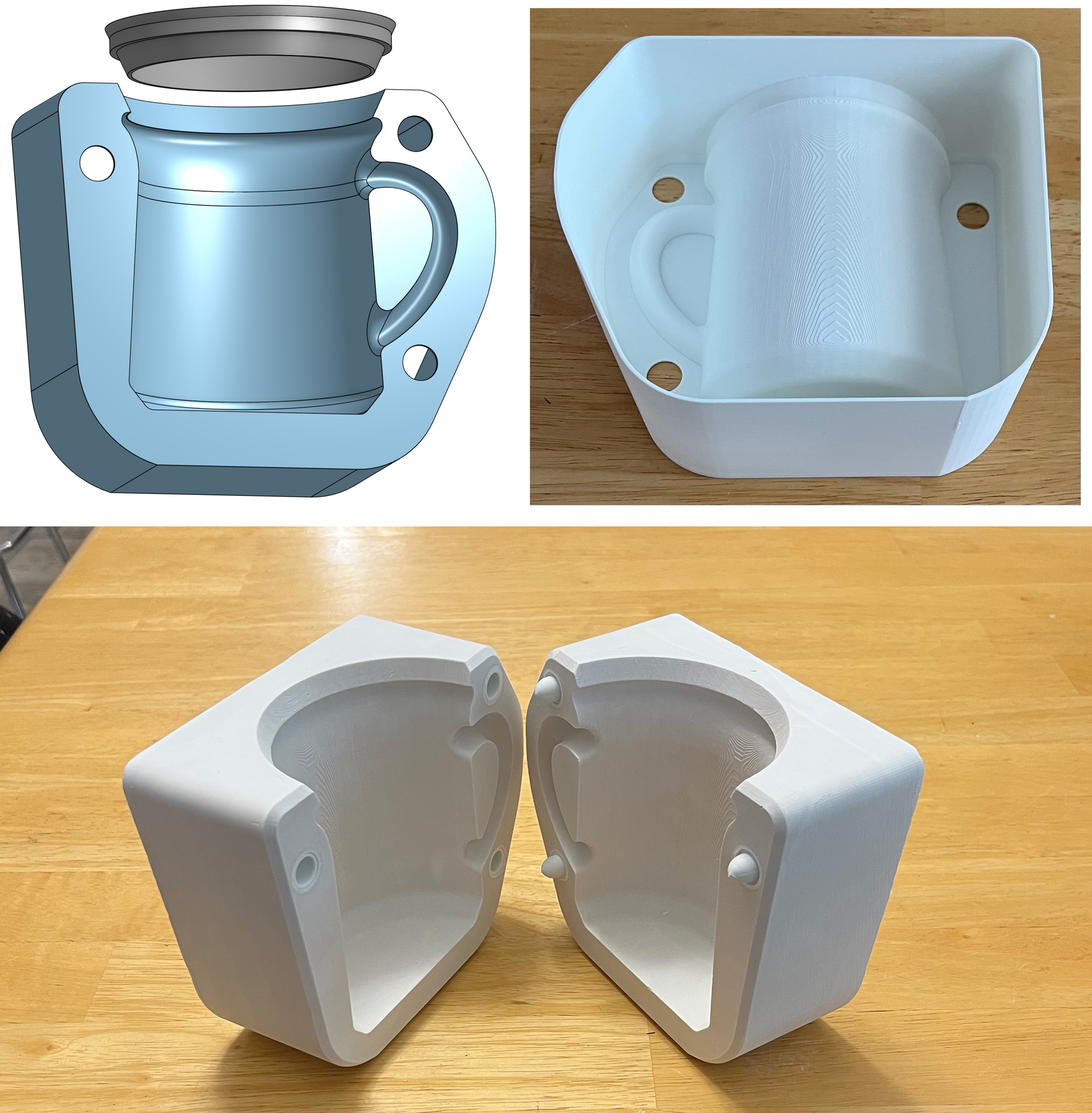
3D-printed Case mold for slip casting
And a working mold made from it
This picture has its own page with more detail, click here to see it.
Top left: The back side of the mold, as it appears in the 3D CAD program (pouring spout also visible).
Top right: A 3D print of the design (another mirrored one of this was also done). The CAD software, OnShape, exported the design in 3MF format to the slicer software (in this case, Prusa Slicer). The slicer software produces a g-code file that the printer needs to create this, layer by layer. Although the walls are only 0.8mm thick, and this mold only weighs 100g, it is surprisingly strong. The holes are for our mold natch system (clips inserted from the back side hold embeds in place, they are thus cast into the plaster).
Bottom: A plaster working mold. Each half was made by pouring plaster into the case molds (top right). The case mold was removed using a heat gun.
Although printing artifacts are visible, we either do not regard them as a problem, work to enhance them, or remove them for production case molds.
 PayPal | No tracking, No ads, No paywall, No transient content! Just organized, concise information constantly updated and improved. Was this helpful? Consider supporting me. |
| By Tony Hansen Follow me on        |  |
Got a Question?
Buy me a coffee and we can talk 

https://digitalfire.com, All Rights Reserved
Privacy Policy