0.8mm thickness | 200 mesh | 325 mesh | 3D Design | 3D Modeling | 3D Printer | 3D Printing Clay | 3D Slicer | 3D-Printing | 42 mesh | A.I. in Ceramics | Abrasion Ceramics | Acidic Oxides | Agglomeration | AI at Digitalfire | Alkali | Alkaline Earths | All-in-one case mold | Amorphous | Apparent porosity | Artware | Ball milling | Bamboo Glaze | Base Glaze | Base-Coat Dipping Glaze | Basic Oxides | Batch Recipe | Bisque | Bit Image | Black Core | Bleeding of colors | Blender Mixing | Blunging | Body Bloating | Body glaze Interface | Body Warping | Bone China | Borate | Boron Blue | Boron Frit | Borosilicate | Breaking Glaze | Brick Making | Brushing Glaze | Calcia Matte | Calcination | Calculated Thermal Expansion | Candling | Carbon Burnout | Carbon trap glazes | CAS Numbers | Casting Rate | Casting Slip | Casting-Jiggering | Catch Glaze | Celadon Glaze | Ceramic | Ceramic Binder | Ceramic Decals | Ceramic Glaze | Ceramic Glaze Defects | Ceramic Ink | Ceramic Material | Ceramic Oxide | Ceramic Slip | Ceramic Stain | Ceramic Tile | Ceramic Transfer | Ceramics | Characterization | Chemical Analysis | Chromaticity | Clay | Clay body | Clay Body Porosity | Clay Stiffness | Clays for Construction | Clays for Ovens and Heaters | Code Numbering | Coil pottery | Colloid | Colorant | Commercial hobby brushing glazes | Cone 1 | Cone 5 | Cone 6 | Cone plaque | Content Management System | Copper Red | Cordierite Ceramics | Crackle glaze | Creative Commons Attribution | Cristobalite | Cristobalite Inversion | CRM | Crucible | Crystalline glazes | Crystallization | Cuerda Seca | Cutlery Marking | Decomposition During Ceramic Firing | Deflocculation | Dehydration | Differential thermal analysis | Digitalfire API | Digitalfire Foresight | Digitalfire Insight | Digitalfire Insight-Live | Digitalfire Reference Library | Digitalfire Taxonomy | Dimpled glaze | Dinnerware Safe | Dip Glazing | Dipping Glaze | Dishwasher Safe | Displacer | Do-It-Yourself | Drop-and-Soak Firing | Drying Crack | Drying Performance | Drying Shrinkage | DTA Test | Dunting | Dust Pressing | Earthenware | Efflorescence | Encapsulated Stain | Engobe | Eutectic | Fast Fire Glazes | Fat Glaze | FDM, SLA, SLS, MEX 3D printing technologies | Feldspar Glazes | Filter Press | Fining Agent | Firebrick | Fireclay | Fired Strength | Firing Schedule | Firing Shrinkage | Flameware | Flashing | Flocculation | Fluid Melt Glazes | Flux | Food Safe | Foot Ring | Forming Method | Formula Ratios | Formula Weight | Frit | Fritware | Functional | GHS Safety Data Sheets | GitHub | Glass vs. Crystalline | Glass-Ceramic Glazes | Glaze Blisters | Glaze Bubbles | Glaze Chemistry | Glaze Compression | Glaze Crawling | Glaze Crazing | Glaze Durability | Glaze fit | Glaze Gelling | Glaze laydown | Glaze Layering | Glaze Mixing | Glaze Recipes | Glaze shivering | Glaze Shrinkage | Glaze thickness | Globally Harmonized Data Sheets | Glossy Glaze | Green Strength | Grog | Gunmetal glaze | Hand Building Techniques | High Temperature Glaze | Hot Pressing | Incised decoration | Industrial clay body | Infill and Support | Ink Jet Printing | Inside-only Glazing | Iron Red Glaze | Jasper Ware | Jiggering | JSON | Kaki | Kiln Controller | Kiln Firing | Kiln fumes | Kiln venting system | Kiln Wash | Kneading clay | Kovar Metal | Laminations | LAS Body | Leaching | Lead in Ceramic Glazes | Leather hard | Limit Formula | Limit Recipe | Liner Glaze | Liner Glazing | Liquid Bright Colors | LOI | LOI-Adjust | Low Temperature Glaze | Magnesia Matte | Majolica | Managed Service Provider | Marbling | Material Sense | Matte Glaze | Maturity | Maximum Density | MDT | Mechanism | Medium Temperature | Melt Fluidity | Melting Temperature | Metal Oxides | Metallic Glazes | Micro Organisms | Microwave Safe | Mineral phase | Mineralogy | Mocha glazes | Mohs Hardness | Mold Natches | Mold Shell Flange | Mole% | Monocottura | Mosaic Tile | Mottled | Native Clay | Non Oxide Ceramics | Oil-spot glaze | Once-Fire | Opacifier | Opacity | Ovenware | Overglaze | Oxidation Firing | Oxide Interaction | Oxide Molecular Formula | Oxide System | Particle classification | Particle orientation | Particle Size Distribution | Particle size reduction | Particle Sizes | PCE | Permeability | Phase Diagram | Phase Separation | Physical Testing | Pinholing | Plainsman Clays | Plaster Bat | Plaster table | Plasticine | Plasticity | Plucking | Porcelain | Porcelain Insulators | Porcelaineous Stoneware | Portable Document Format | Pour Glazing | Pour Spout | Powder Carrier | Powder Processing | Precipitation | Primary Clay | Primitive Firing | Propane | Propeller Mixer | Pugmill | Pyroceramics | Pyrometric Cone | Quartz Inversion | R2O:RO Ratio | Raku | Reactive Glazes | Reduction Firing | Reduction Speckle | Refiring Ceramics | Refractory | Refractory Ceramic Coatings | Representative Sample | Residual Quartz | Restaurant Ware | Rheology | Rutile Blue Glazes | Salt and Soda firing | Sanitary ware | Sculpture | Search Engine Optimization | Secondary Clay | Shino Glazes | Side Rails | Sieve | Sieve Shaker | Silk screen printing | Sintering | Slaking | Slip Casting | Slip Trailing | Slipware | Slurry | Slurry Processing | Slurry Up | Soaking | Soluble colors | Soluble Salts | Specific gravity | Splitting | Spray Glazing | Stain Medium | Stoneware | Stull Chart | Sulfate Scum | Sulfates | Surface Area | Surface Tension | Suspension | Tapper Clay | Tenmoku | Terra Cotta | Terra Sigilatta | Test Kiln | TGA Test | Theoretical Material | Thermal Conductivity | Thermal Expansion in Ceramic Bodies and Glazes | Thermal shock | Thermocouple | Thixotropy | Throwing | Tipping point | Tony Hansen | Toxicity | Trafficking | Translucency | Transparent Glazes | Triaxial Glaze Blending | Ultimate Particles | Underglaze | Unity Molecular Formula | Upwork | Variegation | Viscosity | Vitreous | Vitrification | Volatiles | Water Content | Water in Ceramics | Water Smoking | Water Solubility | Weathering of Clays | Wedging | Whiteware | WooCommerce | Wood Ash Glaze | Wood Firing | WordPress | Zero3 | Zero4 | Zeta Potential

Volatiles

Substances that escape as gases during ceramic firing. Many are products of decomposition. For example, calcium carbonate decomposes into CaO and CO₂ gas, losing 44% of its weight. Other common volatiles include water vapour and gases containing carbon, sulphur, fluorine or nitrogen. Their release contributes to loss on ignition (LOI) and can cause glaze defects such as bubbles, pinholes and blisters.

Volatilization is also the process by which substances enter the gas phase and escape during firing. It is not necessarily combustion or decomposition. It can also involve the loss of desirable glaze constituents, such as boron, sodium, potassium or zinc, through the formation and escape of volatile species at high temperatures. Vaporization is a related, more specific term describing the transition from liquid to gas.

Material or process Approx. temperature Volatile
Physically held water Below 200°C Evaporation; not decomposition
Organic matter 200–800°C Oxidation and gas release; atmosphere-dependent
Hydrated lime 400–500°C Releases H2O
Kaolinite 450–650°C Dehydroxylation; releases H2O
Calcium carbonate 650–900°C Releases CO2
Dolomite 600–900°C Decomposes in stages; releases CO2
Certain sulphates Variable, sometimes above 1000°C Release sulphur-containing gases

These are approximate temperature ranges, not fixed decomposition points. Mineral purity, particle size, heating rate, kiln atmosphere and interactions with other materials can significantly change the temperatures at which reactions occur.

Related Information

LOI horse race with a surprising winner and loser
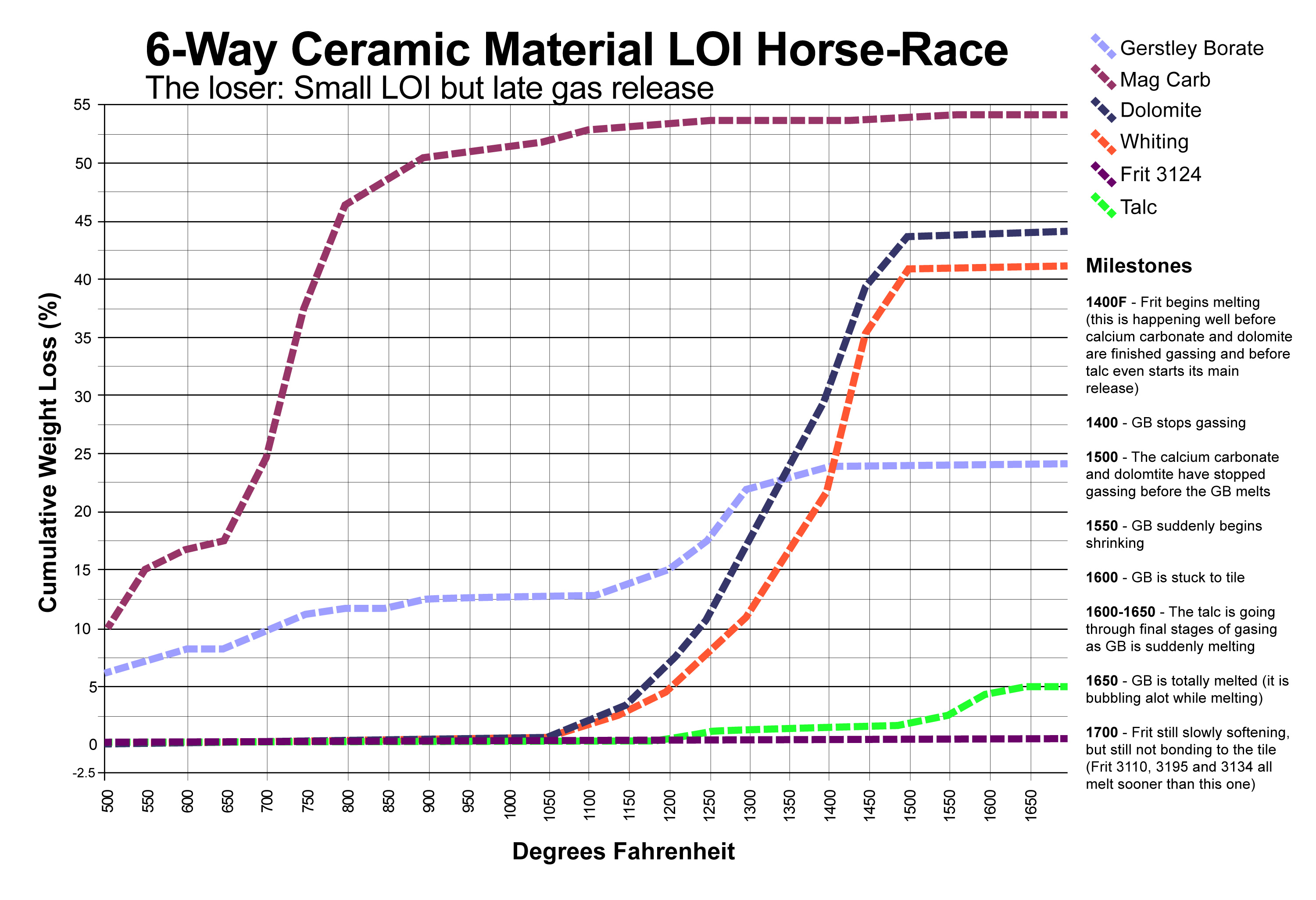

A chart showing weight-loss vs firing temperature for common ceramic materials

This picture has its own page with more detail, click here to see it.

This chart compares the decompositional off-gassing (% weight Loss on Ignition) behavior of six glaze materials (there are many more). Each was heated through the range 500-1700F at 350F/hr. It is amazing how much weight some can lose on firing. For example, 100 grams of calcium carbonate generates 44 grams of CO2! Magnesium carbonate even more. But the main message of this chart is that some late gassers overlap early melters. That can be a problem (causing glaze bubbles, blisters, pinholes). The talc in this test is an example: It did not finish gassing until 1650F. Yet many fritted and Gerstley Borate glazes have already begun melting by then.

There are two takeaways here. The biggest weight loser is not the biggest troublemaker. What matters is how gas release overlaps glaze sealing. Calcium carbonate illustrates this; its high carbonate content can still produce a clear glaze (when gases can clear ahead of any melting). And the talc, although having a small LOI, is a potential troublemaker when the glaze melt cannot effectively clear the bubbles.

Links

Glossary Decomposition During Ceramic Firing
How ceramic raw materials decompose during firing, releasing water, carbon dioxide and other gases that can cause bloating, pinholes and glaze defects.
Glossary Ceramic Glaze Defects
Ceramic glaze defects include things like pinholes, blisters, crazing, shivering, leaching, crawling, cutlery marking, clouding and color problems.

PayPal
No tracking, No ads, No paywall, No transient content!
Just organized, concise information constantly updated and improved.
Was this helpful? Consider supporting me.
By Tony Hansen
Follow me on

Got a Question?

Buy me a coffee and we can talk


https://digitalfire.com, All Rights Reserved
Privacy Policy