
Contact MeLet's have a Other ways to Support My WorkSubscribe to Insight-Live.com. It is about DIY testing and development, not letting information slip away. Help Me on Social

Login to your online account Chemistry plus physics. Maintain your recipes, test results, firing schedules, pictures, materials, projects, etc. Access your data from any connected device. Import desktop Insight data (and of other products). Group accounts for industry and education. Private accounts for potters. Get started. 
Download for Mac, PC, Linux Interactive glaze chemistry for the desktop. Free (no longer in development but still maintained, M1 Mac version now available). Download here or in the Files panel within your Insight-live.com account. What people have said about Digitalfire
What people have said about Insight-Live
| Monthly Tech-Tip from Tony HansenI will send practical posts like these (from thousands I maintain). No ads or tracking. The first email will provide one-click unsubscribe. Signup is being email-bombed by bots. For now, please subscribe inside your insight-live.com account. BlogPetalite for Lithium Carbonate:It takes eight times as much!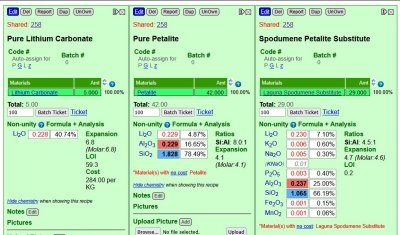
Here are the three common lithia source materials in a side-by-side calculation to compare their potencies. I have adjusted the material weights so that all are delivering the same amount of Li2O (assuming a recipe calling for 5% lithium carbonate). Context: Why Petalite and Spodumene.., GLC Wednesday 2nd September 2026 Pure Nepheline Syenite as a crackle glaze:Its chemistry explains exactly why crackle glazes crack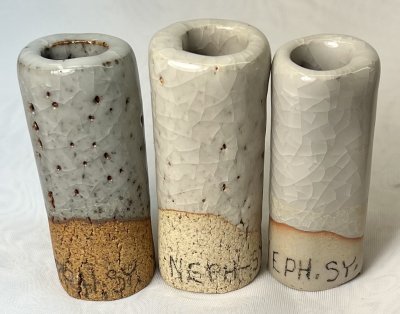
Crackle glazes are often thought of simply as recipes that somehow produce a crack pattern. However, crackle is a glaze/body fit phenomenon, not simply an intrinsic visual property of the glaze. They have very high levels of Na2O and/or K2O (collectively, KNaO). These two have the highest co-efficients of thermal expansion, by far, of oxides commonly found in pottery glazes. Feldspars, and particularly nepheline syenite, can supply them in abundance. Context: Mechanism, Crackle glaze Tuesday 1st September 2026 Redart has a published chemical analysis:But it doesn’t indicate what you might think
This slurry is 100% traditional Redart. This deep red color is a product of the high percentage of iron oxide in its chemical analysis. But that chemistry provides a good example of why using the classical ceramic rational-analysis method to derive a theoretical mineralogy can be misleading for an illitic clay (which this is). Context: Redart, Redart 2 1 test.. Monday 31st August 2026 Brushing glazes on large bowls:Pour-feed the brush in one long stroke
On the left I applied pure Ravenscrag slip, as a glaze, inside and out, using only a small brush. I did the same to the bowl on the right, using the G1947U transparent glaze. Both of H550 clay. We almost always use these as dipping glazes. But here I mix them as brushing glazes, adding 10g CMC gum powder to one liter of a water-reduced version of the slurries. Blender mixing makes it possible to mix in the powdered gum and tune water content for the best brushing experience. The gum slows down the drying speed dramatically so there is plenty of time to brush it into place (while the wheel is turning). The gum also greatly increases the cohesion, enabling pouring out of a pitcher in a long thin stream. In this firing I also glazed a leather hard 40-inch tall vase and a 35 lb bone-dry bowl using the same technique. The evenness of coverage was the best I have ever gotten (of any technique) on large sizes and shapes. Context: Add CMC gum to.., Glaze large bowls inside-and-out.., DIY brushing glazes by-the-jar.., Youtube Video Brush Glazing.., Brushing Glaze Sunday 30th August 2026 Bubbles in a fritted cone 6 glaze:What are the options?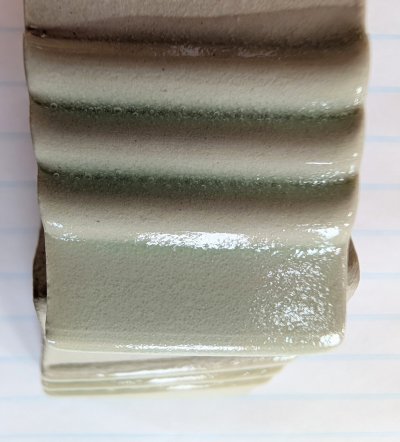
This is a cone 6 transparent fritted glaze (converted from a Gerstley Borate one). Its B2O3 content is high, sourced by Ferro Frit 3134. Bubbles in transparent glazes often plague potters; many just keep trying new glazes until one works, or give up on never finding one. Why not try to fix this problem? Is thickness the issue?A bubble has farther to travel through a thick glaze, and the volume of bubble-generating material is greater. A glaze that clears beautifully at 0.3–0.4 mm can become a bubble bath at 0.8–1.0 mm. Often when potters find a glaze that works, they have just found one that goes on thinner and more evenly.Is it the frit?This frit begins softening and participating in glass formation as early as 1350°F, while decomposition gases may still be arriving from clays, carbonates, the body, organics, etc. In an industrial fast-fire kiln, they need late-melters, not bubble-trappers like this. They employ fast-fire frits that melt later. That being said, potters do have flexible firing, so this could still be made to work by slowing down the firing leading up to 1350. It also could be held at top temp, then either slow-cooled or a drop-and-hold.Is it the recipe?Notice the big bubbles; they started as little ones that merged. Given enough time, big ones break at the surface, but only under the right conditions: Low enough melt viscosity and surface tension. Strangely, some old recipes sourcing high boron from Gerstley Borate had surprisingly few problems with bubbles! Why? While GB has substantial LOI itself, it appears that it can be its own fining agent with the right viscosity-versus-temperature curve. Its boron enters the melt later, and the melt develops unevenly, and may create localized channels and variable viscosity zones for easier bubble escape. The larger bubbles may better move laterally by combinations of lower surface tension, layer thickness and temperature gradients, and downward movement that creates shear.Is it the melt surface tension?Let's assume this glaze melt has high surface tension. It pulls liquid inward around each bubble, stabilizing them round and making rupture more difficult. But if surface tension drops, even slightly, bubbles deform more easily and adjacent ones merge. What could help? Industrial technicians have found that surprisingly small recipe changes can really help with bubble release.
Context: Gerstley Borate vs Frit.., Four boron frits with.., Glaze Bubbles Saturday 29th August 2026 A high-expansion glaze can actually bow a plate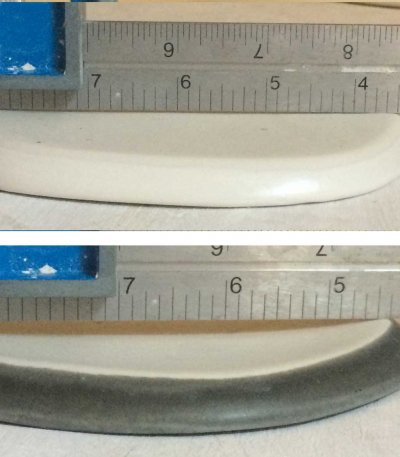
The calculated thermal expansion of this glaze is 8.8, very high because of its high KNaO and low SiO2. These plates are unglazed on the underside. The upper one has a well-fitting glaze and its base remains flat. On the lower one, the high-expansion glaze on the inside contracts much more on cooling and, because it is bonded to the body, ends up in tension. The resulting stress is enough to pull the plate out of shape, bowing the base upward. This issue is common with ceramic tile, where an otherwise flat tile bows as the two layers contract differently on cooling. Context: Thermal Expansion in Ceramic.., Calculated Thermal Expansion Wednesday 26th August 2026 Custer Feldspar update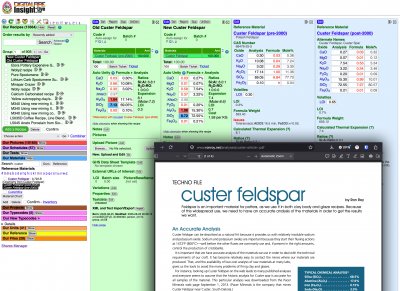
The chemistry for Custer Feldspar has been updated in the materials at Digitalfire and Insight-live. Until now, the Pacer-published values have been used, but at Ron Roy's request, this has been changed (see the link to his article below). The average of assays done from 2000 to 2012 has been used for the chemistry. The material name has been changed to "Custer Feldspar (post-2000)". However, Insight-live will still find it in recipes when needing its chemistry, since "Custer Feldspar" has been included as an alternate name. The old material's name has been changed to "Custer Feldspar (pre-2000)". Context: Ron Roy article about.. Tuesday 25th August 2026 Rutile in functional glazes:Push the limit and you might get this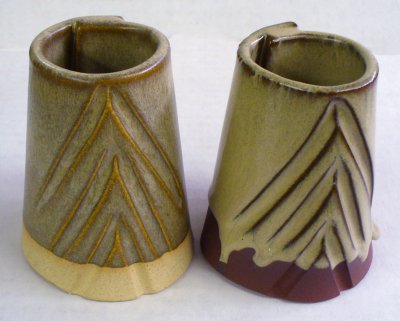
The 80:20 GA6-A Alberta Slip base becomes oatmeal-like when oversaturated with rutile and/or titanium (left: 6% rutile + 3% titanium dioxide; right: 4% rutile + 2% titanium dioxide). The rough surface results from excessive crystallization of titanium-bearing phases from the melt during cooling. It is unpleasant to touch, readily shows cutlery marking and is less desirable for functional surfaces. In glazes of this type, rutile additions above about 4% can become increasingly difficult to keep smooth and consistent. Crystallization, rather than phase separation, increasingly dominates the variegation mechanism. Context: Ceramic Rutile, GA6-F, High-rutile titanium glazes Great.., Leaching, Crystallization, Food Safe, Rutile Blue Glazes Tuesday 25th August 2026 This talc artware body looked white...Until I put it beside a cone 04 porcelain!
On the right is L213, a body made using Texas talc and Kentucky ball clay. On the left is L3778H, a translucent cone 6 porcelain made using Grolleg kaolin, Nepheline syenite and silica. These test tiles were in the same cone 04 firing. Since both of these bodies have similar porosities and fired strengths at cone 04, does that mean one could use the porcelain? It appears the answer is yes. Why is that again? Because low-temperature artware clay doesn’t need vitrification; all the bodies are porous. Context: Artware Monday 24th August 2026 Why is spodumene so expensive?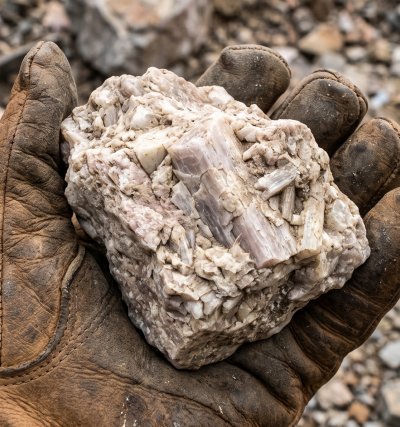
Industrial spodumene is found in massive quantities across major mining regions like Australia, Africa, and North America. Yet if this 1.5kg rock was pure spodumene, it could be ground and sold for $45 (prices at ceramic suppliers in UK, US and Australia are about $31-35/kg in June 2026). The actual mining commodity price is US$2,100/tonne, pricing this rock at $3. That means finely ground ceramic spodumene is currently selling for 10+ times the mine/concentrate price. The battery industry is responsible; it has effectively repriced a ceramic feldspathic mineral as "lithium ore"! Context: Why is tin oxide.., Why Petalite and Spodumene.., How to make Spodumene.. Monday 24th August 2026 |





https://digitalfire.com, All Rights Reserved
Privacy Policy