Glaze Rescue
Taking an alluring recipe found on-line and using recipe logic and materials sense to determine if it is worth spending time on. Quite often, reactive glazes (the most popular) can be recognized on sight as having many strings attached. Rather than just mixing them as given, it is worthwhile to investigate improving them on the way into your studio or plant. At one extreme, this may just involve transplanting the mechanism into another base. At the other, glaze chemistry can enable a whole range of improvements and fixes.
Related Information
A YOLO glaze recipe gets a reprieve
This picture has its own page with more detail, click here to see it.
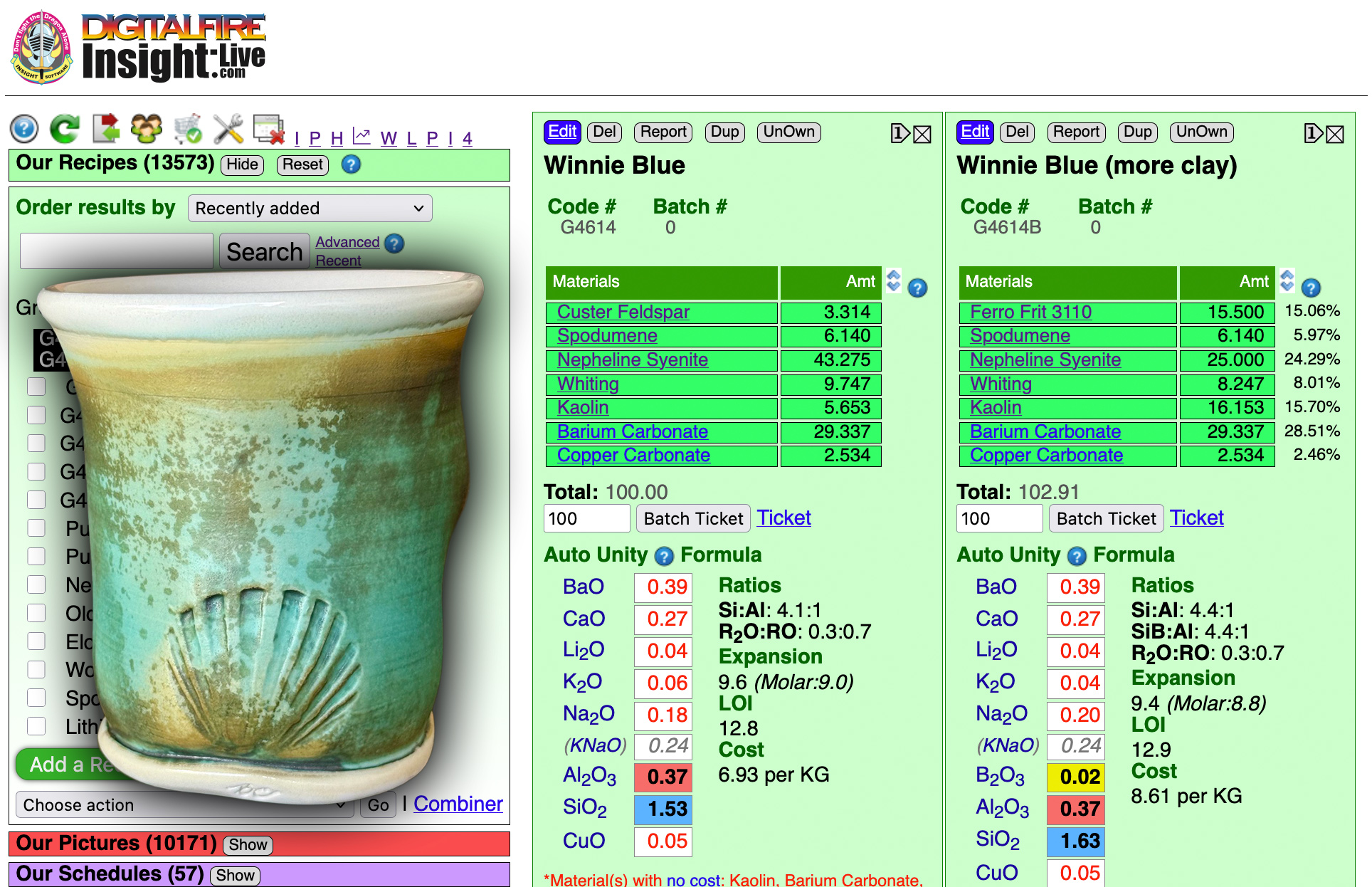
This recipe is pretty far out on the edge for a glaze rescue. But the potter loves the appearance, so it is still worth preserving for decorative or non-food-contact use. Of course, one must go in with eyes open about its application, fit and durability issues. Consider the obvious red flags:
- Almost 30% barium carbonate, combined with SiO2, this raises serious durability and barium-release concerns.
- Only 5.7% kaolin means poor slurry suspension and troublesome application.
- There is no added silica, and the calculated SiO2 is very low for a high-fire glaze.
- Custer feldspar is no longer available to many users.
- More than 43% nepheline syenite supplies a lot of KNaO, and the very high calculated thermal expansion strongly suggests crazing risk on many bodies.
But this glaze has one thing the potter values: it appearance (see image). So rather than discard it, we reworked the material sourcing while keeping the oxide chemistry very similar. I reduced the nepheline syenite substantially and introduced Ferro Frit 3110 to supply much of the KNaO without bringing much Al2O3 with it. That enabled the kaolin percentage to almost triple, from 5.7% to 16.2%, while calculated Al2O3 stayed at 0.37. The result should be a much more practical slurry while giving the glaze a reasonable chance of retaining the character that made it worth rescuing in the first place.
However, the new recipe still has 29% barium carbonate and a calculated expansion of 9.4, so this is not a “fixed glaze.” It is a more usable version of an intentionally problematic glaze.
Online Glaze Recipe Rescue:
Seeks good home for a magnesia matte blue
This picture has its own page with more detail, click here to see it.
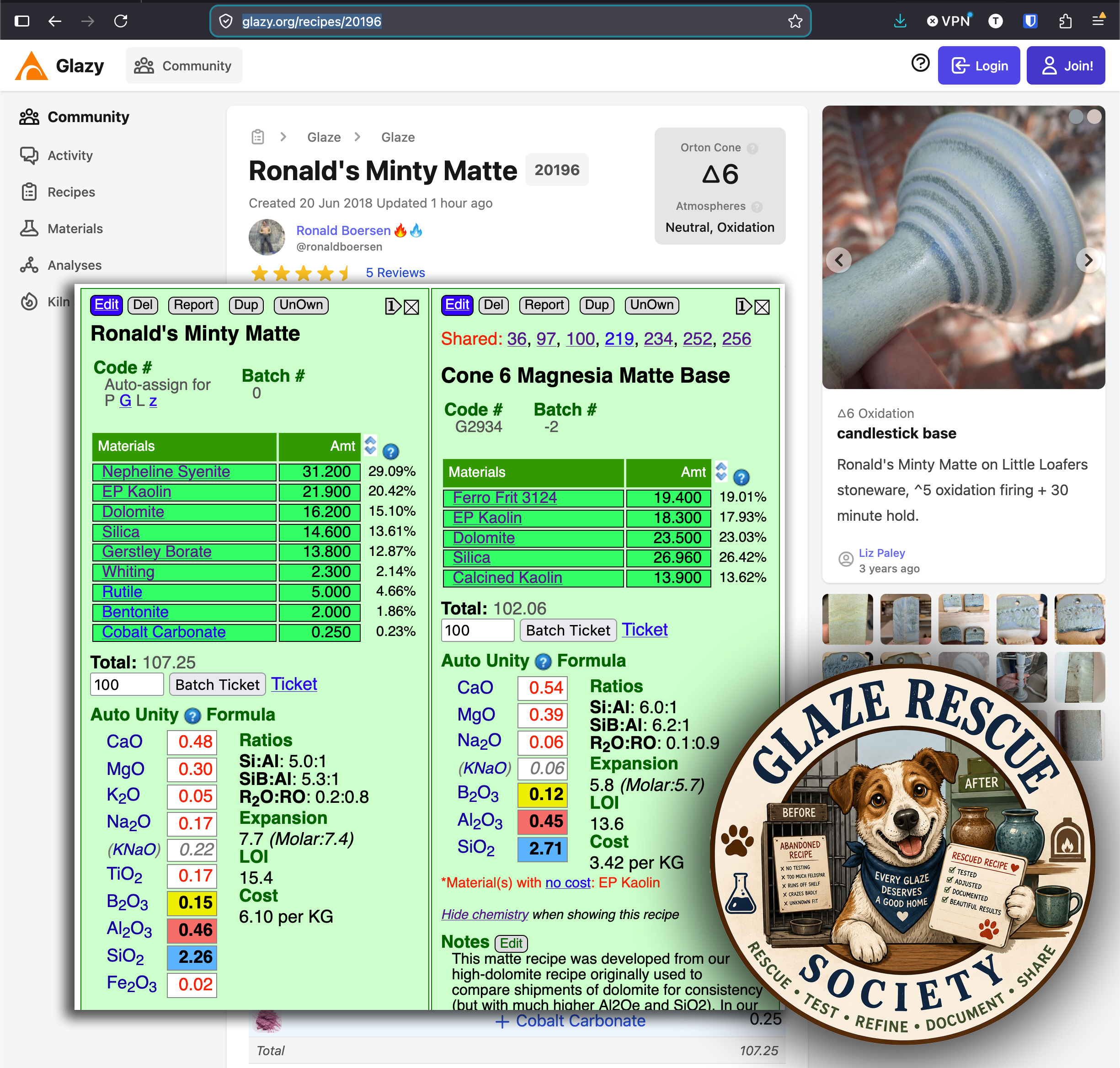
This "Minty Matte" glaze was found wandering in a Facebook group. The current "home" is a base recipe having high nepheline syenite coupled with very low SiO2 (thus high COE). It crazes on most clay bodies used by the potter who contacted me. Its tag traced it to Glazy 20196. I sometimes think of these as "shelter recipes", needing a "glaze rescue". The beautiful appearance of this one provides the motivation to give it a little love and rehome it into a new base recipe! The love it needs is a simple understanding of the mechanism to move: It is rutile saturation in a magnesia matte with a little cobalt to kick the blue. Base recipes aren't carved in stone; the chemistry of this one can be altered to drop the COE a lot (by switching Na2O for MgO). G2934 magnesia matte also works with this mechanism (and has a much lower COE). Transplanting the rutile and cobalt into it would surely reduce crazing.
However, this recipe needs another rescue. From a misunderstanding. Although the potter contacting me was happy with the G2934 as a base for the rutile and cobalt, she had learned that durable glazes should have an R2O vs RO Ratio of around 0.3:0.7 (G2934 is 0.1:0.9). However, the R2O:RO ratio thing is misunderstood. Durability is much more about producing a well-melted homogeneous glass (but not over-fluid) with minimal phase separation and surface crystallization, good body fit and absence of large amounts of easily dissolved colorants.
Li2O from Spodumene instead of Lithium Carbonate:
Good chemistry and economy, but bad physics

This picture has its own page with more detail, click here to see it.
Lithium carbonate is now ultra-expensive. Yet the reactive glaze on the left needs it. Spodumene has a high enough Li2O concentration to be a possible source here. It also has a complex chemistry, but the other oxides it contains are those common to glazes anyway. I did recipe rescue calculations and got a pretty good match in the formulas (lower section in the green boxes). Then I made 10-gram balls and did a GLFL test at 2200F.
Not surprisingly, this recipe is very runny; that's why the tiny yellow crystals grow during cooling. The new version fires very similarly, perhaps better. My calculated cost to mix these in 2022 was $17.84/kg vs. $10.40/kg. In 2026, the difference is even greater! But there is a practical cost: Poor slurry properties. The spodumene sources so much Al2O3 that 70% Alberta Slip had to be dropped to accommodate it! How does one use this type of glaze without ruining kiln shelves? Using a catcher glaze is one answer.
Glazy and Facebook "Glaze Rescues":
Rehabilitate first, then adopt and take them home!

This picture has its own page with more detail, click here to see it.
Many come to Insight-live after bad experiences trying to rescue glaze recipes abandoned on social media. Better to use some recipe logic to rehabilitate them and then give them a loving home. Glazy "Red Orange #111576" is an example of an "adoption" that I did.
It has two things I avoid: Lithium Carbonate (expense) and a high percentage of red iron (slurry gelling). Spodumene is a better source of Li2O, but it contributes lots of Al2O3 and SiO2. We can "make room" for it by replacing the feldspar with Ferro frit 3110 (the latter contributes much more sodium and much less Al2O3/SiO2 than the feldspar). Second, use black iron instead of red.
The results using the C6IRED schedule were fabulous. And the cost is way down. Amazingly, black iron does not gel the slurry at all! And it is not nearly as messy as the red. Like any iron red, it needs to go on thick and has a fluid melt; that's a recipe for running (so a catch glaze is needed). Two pluses: The thermal expansion is lower, so crazing is less likely. The LOI is much lower, which should minimize bubbling.
 PayPal | No tracking, No ads, No paywall, No transient content! Just organized, concise information constantly updated and improved. Was this helpful? Consider supporting me. |
Got a Question?
Buy me a coffee and we can talk 

https://digitalfire.com, All Rights Reserved
Privacy Policy