Ferro Frit 3249
Alternate Names: F3249 Frit, F3249 (Ferro)
Description: Low expansion leadless magnesia borosilicate frit
| Oxide | Analysis | Formula | Tolerance |
|---|---|---|---|
| CaO | 3.50% | 0.17 | |
| MgO | 12.20% | 0.83 | |
| B2O3 | 28.90% | 1.14 | |
| Al2O3 | 13.30% | 0.36 | |
| SiO2 | 42.10% | 1.92 | |
| Oxide Weight | 273.88 | ||
| Formula Weight | 273.88 | ||
Notes
No potter or manufacturer should be without this type of frit (despite how expensive it is). Every frit manufacturer will be making a magnesia borosilicate like this (because it is needed to lower the thermal expansion of glazes and glasses).
Frit 3249, from Ferro (now Vibrantz), is an example of this type. It is valuable because it introduces a form of MgO (the lowest expansion flux) that will melt at much lower temperatures than MgO-sourcing raw materials like dolomite or talc (trading some of the high-expansion fluxes in a glaze for MgO is the most effective way to reduce glaze thermal expansion). Also, high MgO is the mechanism of some of the best matte glazes and a frit like this is often the best way to source it.
Ferro specifies this as a bonding agent for grinding wheels. However, frits are sources of oxides, if one supplies the oxides we want and melts well, then it is fine regardless of its label. The process of working this frit into a recipe, to supply some or all of the MgO, is among the most fascinating demonstrations of glaze chemistry. The chemistry of Frit 3249 can be inconvenient at times because it can often oversupply the B2O3 if being used to supply all of the MgO needed.
Fusion frit F-69 has the same chemistry as this, they label theirs a "ceramic frit" (and it has the lowest expansion of any they make). Most other frit manufacturers also make a frit of similar chemistry.
There is some question about how well Ferro maintains the chemistry of this product (and thus whether it is suitable for ceramics). Some users have found variations in the surface quality of their glazes using this. That said, we have found this one to be less soluble than the equivalent Fusion frit (F-69). And far less expensive.
This frit does present an anomaly concerning its use as a source of MgO (instead of raw materials like dolomite and talc). While this generally works well in transparent and stained glazes, producing better clarity and melting, it also seems to attack the aesthetic mechanisms of some reactive glazes that rely on rutile. It is not completely clear why.
Related Information
Frits do not dissolve in water, right? Wrong.

This picture has its own page with more detail, click here to see it.
This is an example of two types of crystals that have formed on the surface of a fritted glaze after a long period of storage (Ferro Frit 3249 in this case). Frits are formulated to give chemistries that natural materials cannot supply. To do that they have to push the boundaries of stability (solubility). Any frit that has an inordinately high amount (compared to natural sources) of a specific oxide (in this case MgO) or lacks Al2O3 (like Frit 3134) are suspect.
Matte cone 6 glazes have identical chemistry but one melts more. Why?

This picture has its own page with more detail, click here to see it.
These are 10 gram GBMF test balls that we melted on porcelain tiles at cone 4 (top two) and cone 6 (bottom two). They compare the melt fluidity of G2934 (left) and G2934Y (right). The Y version sources its MgO from frit and talc (rather than dolomite). It is a much more fluid melt because the frit is yielding the oxides more readily. But Y has a key benefit: It has a much lower LOI, producing fewer entrained air bubbles and therefore fewer surface defects. And, even though it runs much more, it has the same matte surface! As long as it is applied at normal thickness, the extra melt fluidity does not cause any running. And it has another benefit: Less cutlery marking issues. It is actually a very durable and practical food surface glaze, having a low thermal expansion that fits almost any body. Although these appear glossy here, on ware they have the identical pleasant silky matte surface.
Ferro Frit 3249 vs Fusion F-69 at cone 04

This picture has its own page with more detail, click here to see it.
The chemistry of these two supposedly interchangeable frits is very similar (the difference being that 3249 has 3% CaO that is missing in F-69). But that does not appear to account for this difference in melt fluidity at cone 04! However, as temperatures increase 3249 rapidly becomes more active. Inspite of the difference here we have found the two work interchangeablely in our G2934Y recipe. Obviously, the F-69 is going to make glazes melt better, at least at low fire.
Frits work much better in glaze chemistry
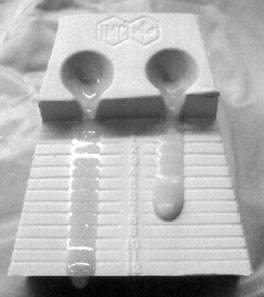
This picture has its own page with more detail, click here to see it.
The same glaze with MgO sourced from a frit (left) and from talc (right). The glaze is 1215U. Notice how much more the fritted one melts, even though they have the same chemistry. Frits are predictable when using glaze chemistry, it is more absolute and less relative. Mineral sources of oxides impose their own melting patterns and when one is substituted for another to supply an oxide in a glaze a different system with its own relative chemistry is entered. But when changing form one frit to another to supply an oxide or set of oxides, the melting properties stay within the same system and are predictable.
Crystallization of Rutile at cone 6 completely subdued? How?

This picture has its own page with more detail, click here to see it.
These glazes are both 80% Alberta Slip, but the one on the right employs 20% Ferro Frit 3249 accelerate the melting (whereas the left one has 20% Frit 3134). Even though Frit 3249 is higher in boron and should melt better, its high MgO stiffens the glaze melt denying the mobility needed for the crystal growth.
A fritted source of MgO has sabotaged the visual character of this glaze

This picture has its own page with more detail, click here to see it.
This is G2917 Ravenscrag floating blue and G2917A. The latter was also supposed to be floating blue. Both are descendants of the original G2826R floating blue, preserving its chemistry but sourcing it from more user-friendly materials. The glaze on the right takes the mechanisms of the other two and compromises the chemistry in the direction of lowering the thermal expansion (to reduce crazing). The use of high-MgO frit 3249 is part of the strategy (instead of sourcing it from talc or dolomite). But this has completely killed the visual! The solution will be to return to the use of talc to source the MgO.
Low expansion version of cone 6 Alberta Slip amber glaze glaze

This picture has its own page with more detail, click here to see it.
Alberta Slip with 20% added frit 3134 (left) fired to cone 6 on a porcelain. This is the standard GA6-A recipe. On the right 20% frit 3249 has been used instead. That is a low expansion frit so if you have crazing with the standard recipe, consider trying this one.
How to adjust the G1916Q low fire clear glaze when it crazes
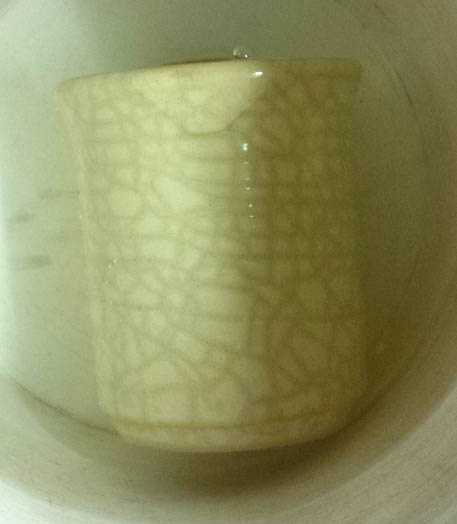
This picture has its own page with more detail, click here to see it.
This is Plainsman Buffstone, fired at cone 04. The piece emerged from the kiln without crazing. The mug was heated to 300F and plunged into ice water (the 300F-to-ice-water IWCT test). This is what happened. Water is being absorbed into the porous body through the craze lines. This is G1916J, a variation on the G1916Q recipe. J is just two materials, 85% Ferro Frit 3195 and 15% EPK. What recipe adjustment is needed? Substitute some of the Frit 3195 for low expansion Frit 3249. We have found that a 55:30:15 of 3195:3249:EPK recipe will work. Since both 3195 and 3249 melt transparent at cone 04, blending them together does not change the appearance (actually, 3249 is glossier and actually improves the surface).
Cone 10R clear glaze made more "clear":
Using frit to source Na2O instead of feldspar
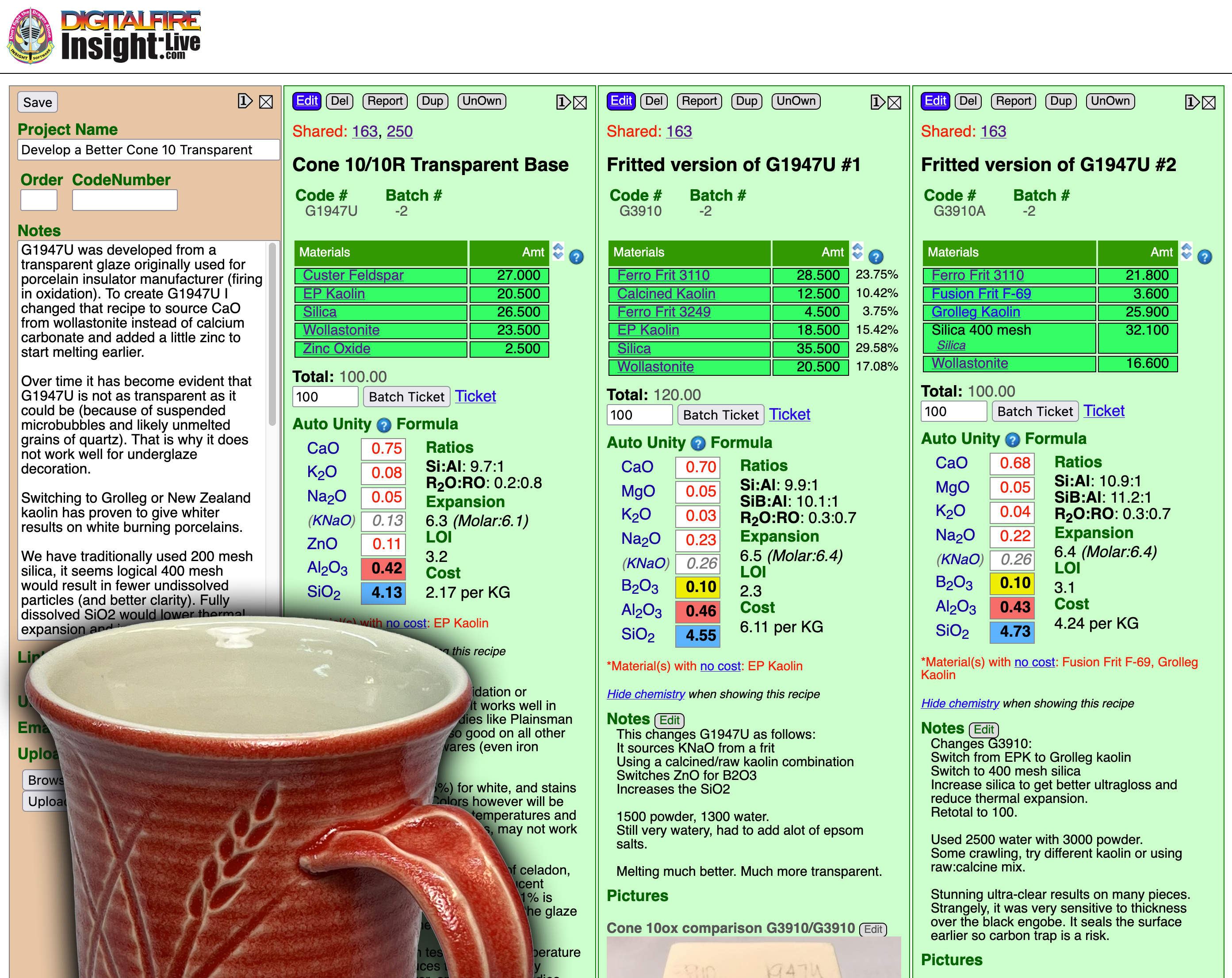
This picture has its own page with more detail, click here to see it.
To get a better, more brilliant transparency than G1947U, at cone 10R, I tried sourcing Na2O from a frit. The inside surface on this mug is the result (v2), it is so glossy it looks like a low-fire leaded glaze. This screenshot of side-by-side panels shows the frit-enhanced version(s), G3910 and G3910A. Frit 3110 has a much higher concentration of KNaO than the feldspar, a key to making a brilliant glass. While this increases the COE, the fact that it comes from this frit brings multiple benefits:
-A brings a little B2O3, a better melter than zinc (which volatilizes anyway at cone 10).
-It dissolves more low-expansion glass-forming SiO2 (in v2 I switched to 400 mesh silica to enhance that even more).
-The glaze can then tolerate some low-expansion MgO (introduced by Frit 3249 or its equivalent, Fusion Frit F-69).
More details about this project can be found by clicking/tapping the Insight-live recipe code numbers G1947U, G3910 or G3910A. The red outside glaze is G2571D1.
GA6A Alberta Slip base using Frit 3124, 3249 and 3195 on dark body

This picture has its own page with more detail, click here to see it.
The body is dark brown burning Plainsman M390 (cone 6). The amber colored glaze is 80% Alberta Slip (raw:calcine mix) with 20% of each frit. The white engobe, L3954B, on the inside of two of the mugs is L3954A (those mugs are glazed inside using transparent G2926B). The Alberta Slip amber gloss glaze produces an ultra-gloss surface of high quality on mugs 2 and 3 (Frit 3249 and 3195). On the outside we see it this glaze on the white slip until midway down, then on the bare red clay. The amber glaze on the first mug (with Frit 3124) has a pebbly surface. These are fired using a drop-and-soak firing schedule. Some caution is required with the 3249 version, it has low thermal expansion (that is good on bodies that normally craze glazes, but risks shivering on ones that do not).
GA6A Alberta Slip base using Frit 3249 and 3195 on buff body

This picture has its own page with more detail, click here to see it.
The body is buff burning Plainsman M340 (cone 6). The amber colored glaze is 80% Alberta Slip (raw:calcine mix) with 20% of each frit. The white engobe on the inside of mug 1 is L3954A (also glazed inside using transparent G2926B). These frits are producing an amber gloss glaze of high quality. On the outside of mug 1 we see the 3195 version on the white slip until midway down, then on the bare buff clay (the other has the 3249 version). These mugs are fired using a drop-and-soak firing schedule. A couple of caveats: Frit 3249 has a very low thermal expansion, use it on bodies that craze other glazes (like Plainsman P300), it could shiver on stonewares like this. Both of these frits prevent the formation of bloating blues (with additions of rutile or titanium).
P300 and M370 mugs with GA6A Alberta Slip (using Frit 3249)

This picture has its own page with more detail, click here to see it.
Rather than the normal 80:20 AlbertaSlip:Frit3134 recipe, this one substitutes Frit 3249 (super low expansion). The glaze is less runny and even glossier on these Plainsman porcelains. They are fired at cone 6 in a cool-and-soak firing. They survived an BWIW test (boiling water:ice water) without crazing (likely because of the low expansion of frit 3249). The finish is dazzling, a brilliant amber glass with no defects and perfectly even coverage. Of course, the iron in the glass prevents the colors of the blue underglaze from showing through. But the black is great.
Devitrification of a transparent glaze

This picture has its own page with more detail, click here to see it.
This glaze consists of micro fine silica, calcined EP kaolin, Ferro Frit 3249 MgO frit, and Ferro Frit 3134. It has been ball milled for 1, 3, and 6 hours with these same results. Notice the crystallization that is occurring. This is likely a product of the MgO in the Frit 3249. This high boron frit introduces it in a far more mobile and fluid state than would talc or dolomite and MgO is a matting agent (by virtue of the micro crystallization it can produce). The fluid melt and the fine silica further enhance the effect.
Common North American pottery frits:
Do you know what each one is used for?
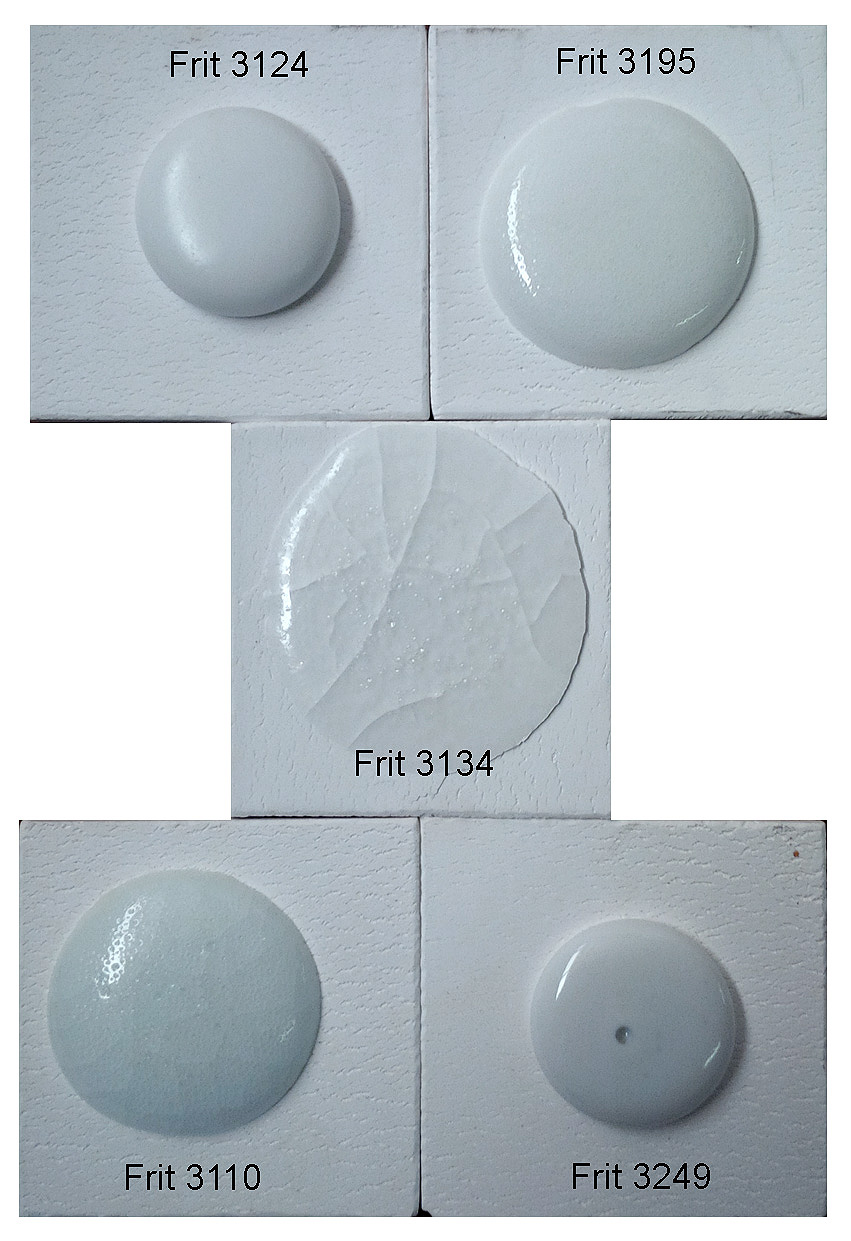
This picture has its own page with more detail, click here to see it.
These 10-gram GBMF test balls were melted at 1850F.
Chart showing the chemical analysis of each (tap/click the triangle)
| Ferro | Frit 3134 | Frit 3124 | Frit 3195 | Frit 3110 | Frit 3249 |
|---|---|---|---|---|---|
| MgO | 12.2 | ||||
| CaO | 19.5 | 14.3 | 11.4 | 6.3 | 3.5 |
| Na2O | 10.1 | 6.4 | 5.7 | 15.2 | |
| Al2O3 | 2 | 10 | 12 | 3.7 | 13.3 |
| B2O3 | 22.8 | 13.7 | 22.6 | 2.6 | 28.9 |
| K2O | 0.7 | 2.4 | |||
| SiO2 | 45.6 | 54.9 | 48.3 | 69.8 | 42.1 |
| COE | 9.5 | 8 | 7 | 10 | 4 |
| Si:Al Ratio | 38.7:1 | 9.3:1 | 6.8:1 | 32:1 | 5.4:1 |
| R2O:RO Ratio | 0.3:0.7 | 0.3:0.7 | 0.3:0.7 | 0.7:0.3 | |
- 3124, 3134 and 3195 are boron-melted and have R2O:RO ratios of 0.3:0.7. 3124 and 3195 are glaze-like and can be turned into transparent low-temperature glossy glazes with a simple 10-15% kaolin addition (in stoneware glazes they comprise ~20-40%). 3195 has lower Si:Al ratio, so it is not as glossy.
- 3134 is not glaze-like (its Si:Al ratio is 39:1, B2O3 is very high, and its high thermal expansion would craze on any clay body). Its role is as a "B2O3 source" for glazes (add it to make them melt more while having a low probability of upsetting other aspects of the chemistry).
- High-soda 3110 is a "crackle glaze minus the kaolin". It has so much Na2O that it doesn't even need high-boron to melt it. The button has cracked like the 3134. 3110 raises the thermal expansion of glazes. 3110 is the best frit for use in bodies, a super-feldspar.
- The high-magnesia, high-boron 3249 is made for the abrasives industry. But it delivers the same oxides we use in ceramic glazes. Its high-magnesia is the best strategy for holding down thermal expansion of glazes and producing MgO mattes. Its high B2O3 is the key to how a formulation with this much MgO can melt this well.
Melt fluidity comparison - 1750F

This picture has its own page with more detail, click here to see it.
Fired at 350F/hr to 1750F and held for 15 minutes. Frit 3110 has taken off. And F75, 3195 and 3134 (the latter two having big differences in surface tension).
Various frits fired at 1950F

This picture has its own page with more detail, click here to see it.
These sixteen GBMF test balls have melted down onto a slab of grogged clay. Kiln fired at 108F/hr for the last 100 degrees F and held for 15 minutes. This demonstrates the comparison value of this test and how various frits compare in their melting character.
Frits fired to 2050F

This picture has its own page with more detail, click here to see it.
These are higher temperature frits. 10 gram balls were melted on to this tile.
Various frits fired at 1850F

This picture has its own page with more detail, click here to see it.
16 GBMF tests on a slab of grogged clay. Kiln fired at 108F/hr for last 100 degrees F and held for 15 minutes.
Notice the distinct frit melting patterns:
Can you pick two that share similar chemistry?

This picture has its own page with more detail, click here to see it.
These 10g balls GBMF test balls were fired far lower than typical bisque; notice how many of them are already melting well! Frit 3602 is lead bisilicate. Maybe you always thought lead was the best melter. But it got "smoked" by the Fusion FZ-16 high-zinc, high-boron, zero-alumina frit! However, notice the FZ-16 is crazing badly; that is a problem for many applications using this high KNaO frit. Want to get some of this frit for pottery? You can't; Fusion Ceramics doesn't want to handle retail sales of smaller quantities.
Notice that, at this low temperature, each frit has a distinctive melt fingerprint that makes it recognizable.
Notice that the common North American pottery frits on the bottom row: 3195, 3249, 3124, 3110 (and 3134 in the second row) fire distinctly differently. Notice Fusion F69. It looks like 3249 because it is a substitute for it! F-75 is a substitute for 3110 (sharing the same melting pattern but having different micro-bubble clouding).
Frit Melt Fluidity Comparison - 1800F

This picture has its own page with more detail, click here to see it.
Fired at 350F/hr to 1800F and held for 15 minutes (I already did firings from 1300F-1750F in 50 degree increments, all of them are visible in the parent project). Frit 3110, 3134, 3195, F75 have run all the way down. All of the frits have softened and melted slowly over a range of temperatures (hundreds of degrees). By contrast, Gerstley Borate, the only raw material here, suddenly melted and flowed right over the cliff (between 1600 and1650)! But not before Frit 3602 and FZ16 had done so earlier. Frit 3249 is just starting to soften but F69 (the Fusion Frits equivalent) is a little ahead of it. LA300 and Frit 3124 are starting also. F524, F38, F15 will all be over the end by the next firing. The melt surface tension is evident by the way in which the melts spread out or hold together.
Frit melt fluidity comparison - 1300F

This picture has its own page with more detail, click here to see it.
Fired at 350F/hr to 1300F and held for 15 minutes. Some are still burning off carbon (which seems strange). There are two early leaders: Ferro frit 3110 and Fusion frit F75 are starting to deform (they have almost the same chemistry). Amazingly, these two frits have low boron, they rely on high soda as the flux.
Melt fluidity comparison of frits - 1350F

This picture has its own page with more detail, click here to see it.
Fired at 350F/hr to 1350F and held for 15 minutes. Some are still burning off carbon (which seems strange). The two FZ16s are starting to move. Frit 3134 is expanding. 3602 is also starting to melt.
Melt fluidity comparison of frits - 1400F

This picture has its own page with more detail, click here to see it.
Fired at 350F/hr to 1400F and held for 15 minutes. Frit 3134 is still expanding. 3602 is also starting to flow. A number of them are shrinking and densifying like a porcelain would.
Melt fluidity comparison of frits - 1450F
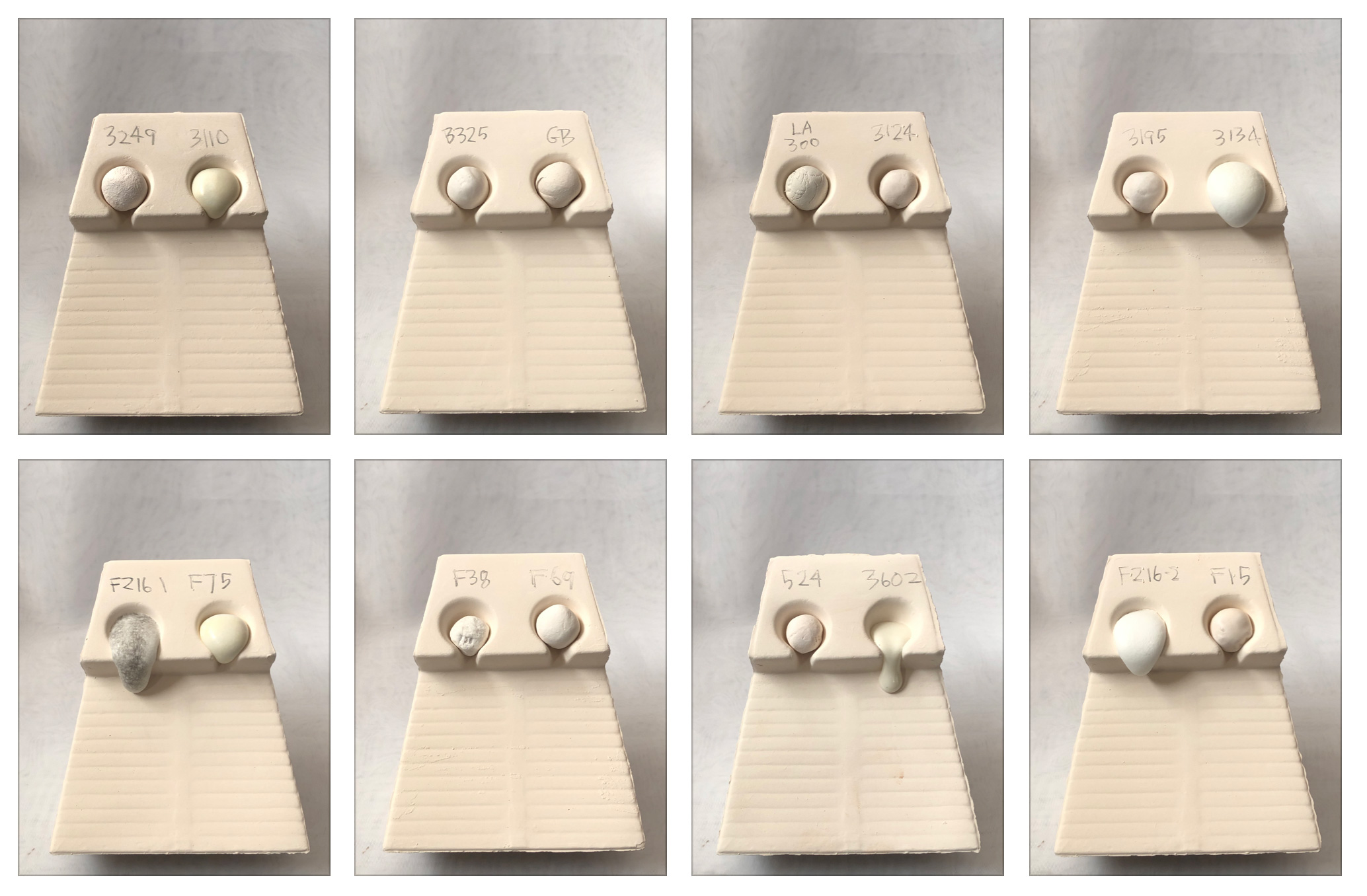
This picture has its own page with more detail, click here to see it.
Fired at 350F/hr to 1450F and held for 15 minutes. Frit 3134 is still expanding. 3602 is blasting out of the gate, taking the lead. F75 is starting to flow.
Frits vs. raw materials in glazes:
It is not just about the chemistry

This picture has its own page with more detail, click here to see it.
These two cone 6 glazes are being compared in a melt-flow tester. Their calculated oxide chemistries are essentially the same, but G2934Y4 sources KNaO from Ferro Frit 3110 rather than feldspar, and much of its MgO from Ferro Frit 3249 rather than the talc used in G2934 (talc is so refractory that it is a key ingredient in making kiln shelves!). The Y4 recipe even sources Al2O3 from calcined alumina (another kiln shelf material!). Yet the fritted glaze flows much farther.
How can the frit make such a difference in the melt, despite the burden of the Al2O3? The feldspar and talc require decomposition/reaction before the oxides become available to the melt, whereas the fritting process has already combined the oxides into a glassy, highly reactive homogeneous form.
Melt fluidity comparison of frits - 1500F

This picture has its own page with more detail, click here to see it.
Fired at 350F/hr to 1500F and held for 15 minutes. Frit 3134 is still expanding. 3602 and FZ16 are really starting to move. 3195, F38 and F15 are softening.
Melt fluidity comparison of frits - 1550F
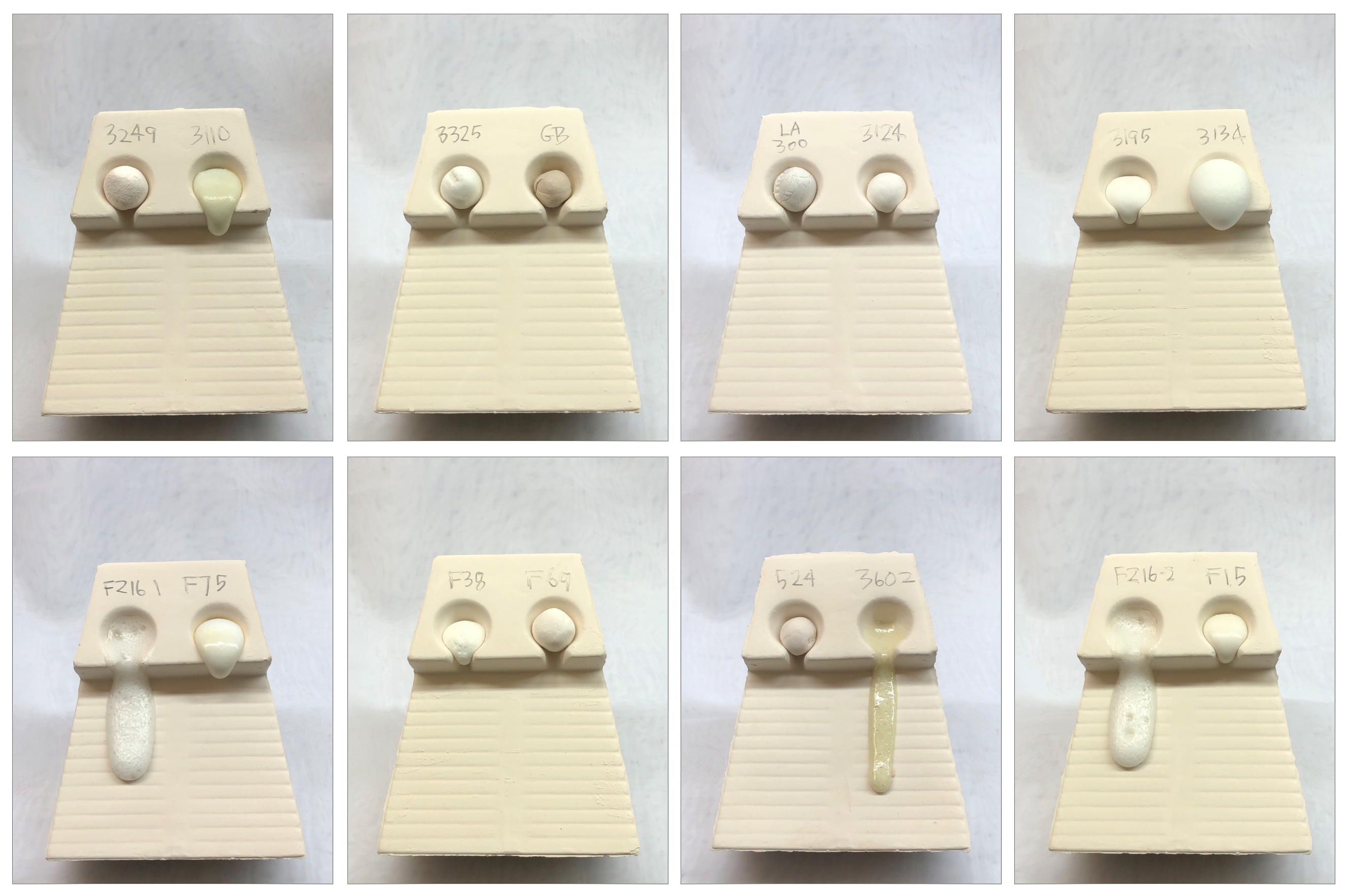
This picture has its own page with more detail, click here to see it.
Fired at 350F/hr to 1550F and held for 15 minutes. Frit 3134 is still expanding. 3602 and FZ16 are going to be off-ramp by next firing.
Melt fluidity comparison of frits - 1650F

This picture has its own page with more detail, click here to see it.
Fired at 350F/hr to 1650F and held for 15 minutes. FZ16 has turned crystal clear and spread out across the runway (has low surface tension). Frit 3110 has so much surface tension that the flow can be lifted off the tester. Since 1600F Gerstley Borate has gone from unmelted to passing all the rest!
Melt fluidity comparison of frits - 1700F

This picture has its own page with more detail, click here to see it.
Fired at 350F/hr to 1700F and held for 15 minutes. 3110 is finally starting to move. 3134 also (being full of bubbles). Gerstley Borate has turned almost transparent (because the Colemanite portion of it is now melting). 3195 is looking very well behaved compared to most others, forming a bubble free glass of high surface tension (F15 and F524 are starting to do the same).
Frit Melt Fluidity Comparison - 1850F

This picture has its own page with more detail, click here to see it.
These melt flow tests were fired at 350F/hr to 1850F and held for 15 minutes (I did firings at 50-degree increments across a wide range). It is amazing how active some frits are, even well below normal bisque temperatures! Frit 3110, Frit 3134, Frit 3195, Frit F-75 have all flowed all the way down for many previous temperatures. LA300 and Frit 3124 were just starting at 1800F, look at them now! Frit F-524 and Frit F-38 have gone from half-way at 1800F to water-falling over the end. Frit 3249 is still not out-of-the-gate but Frit F-69 (the Fusion Frits equivalent of 3249) is half-way. Note how the melt surface tension is evident by the way in which the melts spread out or hold together. By contrast, Gerstley Borate (labelled "GB"), the only raw material here, suddenly melted and flowed right over-the-cliff between 1600 and 1650! The best melter of all of them is high-boron high-zinc Frit FZ-16.
Links
| Articles |
Bringing Out the Big Guns in Craze Control: MgO (G1215U)
MgO is the secret weapon of craze control. If your application can tolerate it you can create a cone 6 glaze of very low thermal expansion that is very resistant to crazing. |
| Materials |
Frit
Frits are made by melting mixes of raw materials, quenching the melt in water, grinding the pebbles into a powder. Frits have chemistries raw materials cannot. |
| Materials |
General Frit GF-144
|
| Materials |
Hommel Frit 2GF11C
|
| Materials |
Fusion Frit F-69
A magnesia borosilicate frit having very low thermal expansion and melting point. Commonly used as a substitute for Ferro frit 3249. |
| Typecodes |
Frit
A frit is the powdered form a man-made glass. Frits are premelted, then ground to a glass. They have tightly controlled chemistries, they are available for glazes of all types. |
| Glossary |
Ovenware
Ovenware clay bodies have a low expansion by virtue of materials in their recipe and/or the way they are fired. But potters bend the rules. |
| Glossary |
Abrasion Ceramics
Man-made ceramic surfaces are among the most abrasion resistant materials known. Products made to abrade others are also made from bonded ceramic grains. |
Data
| Co-efficient of Linear Expansion | 4.00 |
|---|---|
| Frit Melting Range (C) | 1900F |
 PayPal | No tracking, No ads, No paywall, No transient content! Just organized, concise information constantly updated and improved. Was this helpful? Consider supporting me. |
| By Tony Hansen Follow me on        |  |
Got a Question?
Buy me a coffee and we can talk 

https://digitalfire.com, All Rights Reserved
Privacy Policy