A cereal bowl jigger mold made using 3D printing
Beer Bottle Master Mold via 3D Printing
Better porosity for Brown Sugar Savers
Build a kiln monitoring device
Celebration Project
Coffee Mug Slip Casting Mold via 3D Printing
Comparing the Melt Fluidity of 16 Frits
Cookie Cutting clay with 3D printed cutters
DIY Underglaze Development
Evaluating a clay's suitability for use in pottery
Make a mold for 4-gallon stackable calciners
Make Your Own Pyrometric Cones
Make your own sieve shaker to process ceramic slurries
Making a high quality ceramic tile
Making a Plaster Table
Making Bricks
Making our own kiln posts using a hand extruder
Medalta Ball Pitcher Slip Casting Mold via 3D Printing
Medalta Jug Master Mold Development
Mold Natches
Mother Nature's Porcelain - Plainsman 3B
Mug Handle Casting
Nursery plant pot mold via 3D printing
Pie-Crust Mug-Making Method
Plainsman 3D, Mother Nature's Porcelain/Stoneware
Pottery Classes
Project to Document a Shimpo Jiggering Attachment
Roll, Cut, Pull, Attach Handle-making Method
Slurry Mixing and Dewatering Your Own Clay Body
Testing a New Load of EP Kaolin
Using milk as a glaze
Videos of factory workers making holloware
Yixing Teapots
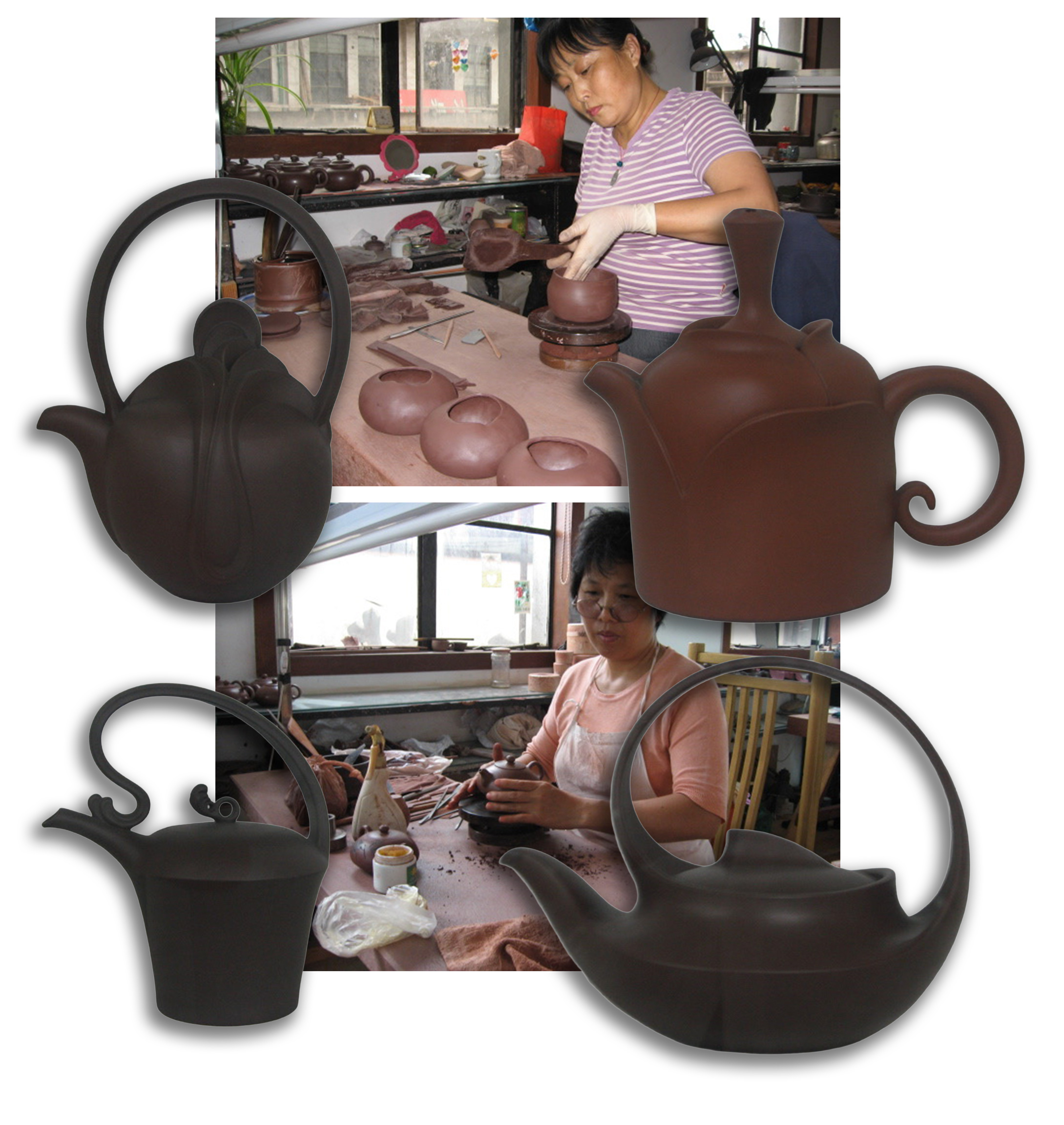
Yixing craftswomen at work
Consider the Magic:
-The ore is rocks; how can they become a workable clay body?
-The clay appears highly plastic yet is not.
-The soft clay has an impossibly low water content.
-Craftsmen flatten the clay with a mallet, instead of rolling it, yet it does not stick to the board.
-Sections are simply glued with slip, and they hold.
-The clay burnishes yet is not smooth.
-Fired ware is smooth yet the soft clay appears sandy.
-The fired surface is glossy yet there is no glaze.
-The clay appears super dense yet does not have porosity (to preserve tea taste).
-The ware shrinks far more than typical pottery, yet does not warp.
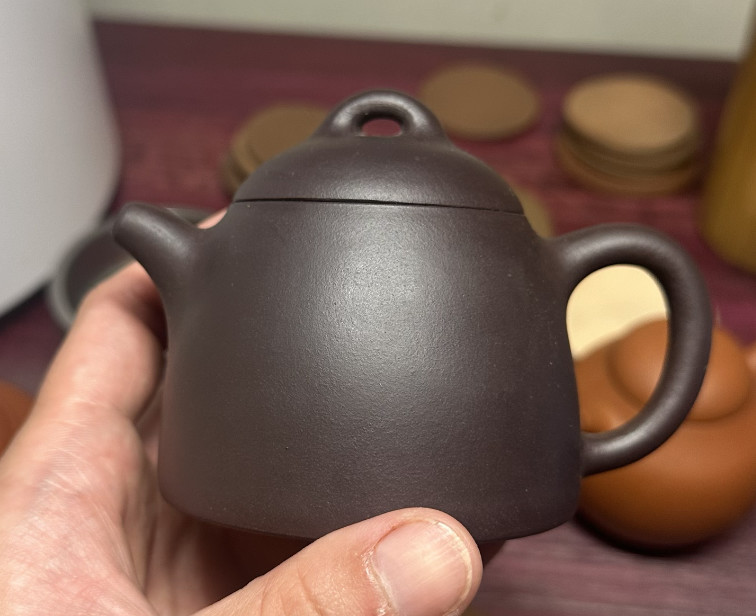
A Yixing teapot, perfectly round yet made by hand!
Working Properties
Plasticity, stiffness: As noted, craftsmen/women appear to handbuild with soft plastic slabs by simply gluing them with slip. But note some things. First, they are not “hand building”, they are assembling/fitting carefully cut polygons. Second, the clay is not plastic in the traditional sense (e.g. it cannot be thrown on a wheel), they must shape it carefully using a paddle. The stiffness imparts impressive wet strength, helping prevent curved forms from collapsing.
Third, the clay is not soft, it is stiff (that's why they have to flatten it with a mallet). Notice during flattening that splits appear on the edges (not an issue since they cut shapes within the slab). Yet the splits are small enough to make it obvious this is not just stiff clay. Very fine and highly plastic clay particles are holding the coarse ones together. Curiously, they make the degree of splitting a visual measure of the right stiffness/plasticity combination.
Texture: Yixing clay is said to be relatively coarse-grained. This statement is misleading. First, it is actually fine-grained but has a significant percentage of coarse grains within. Second, these are not “grains” in the traditional sense, being sand or grog particles. Rather, they are just coarse clay, the same clay. They break down into smaller pieces if enough pressure is applied (making burnishing possible). For this reason, the burnishing persists through firing because the coarse particles shrink with the rest of the clay. The behavior is not perfect, producing the visual graininess in the fired surface (but without feeling that way). The softness of the particles enables another property: The artists can break the particles down to just the right degree when making slip (using a stick on a stone board).
Rewetability: Yixing clay is not suitable for throwing because it is sensitive to water, being rewettable but also disintegrating if too much water is added. The permeability enables it to readily reabsorb moisture in a plaster damp box. This is crucial for multi-session handbuilding, where pieces need to be re-moisturized overnight to continue working. This property testifies to how many coarse particles are needed to impart this permeability. Yixing clay contains much less water than standard clay for the same level of workability. One sample tested had 15% moisture content, and was still too wet to use (drying it to 10-12% moisture was needed). Typical pottery clays are leather hard at this level!
Fired Surface and Appearance
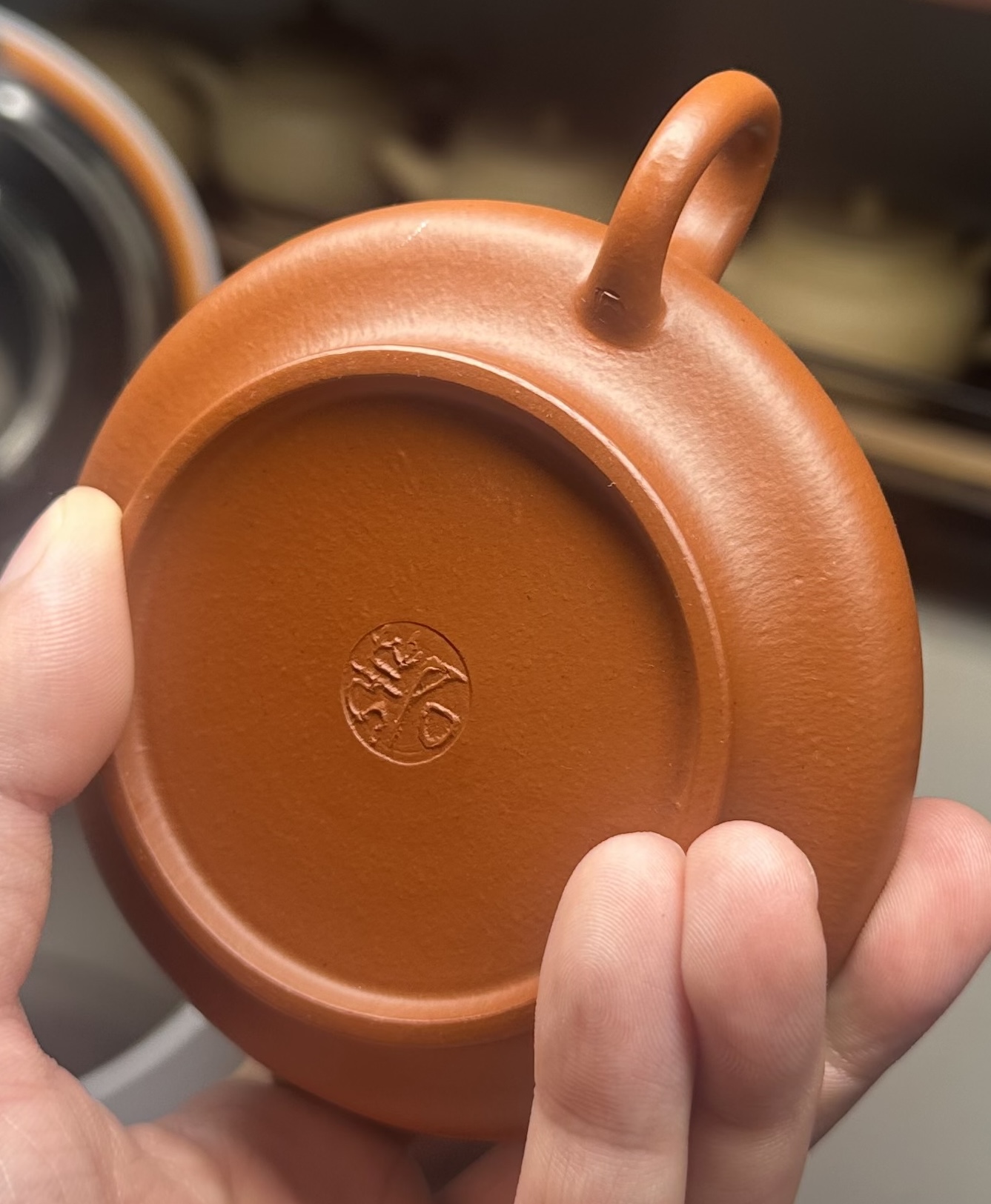
A Yixing teapot, unglazed yet functional!
Color: Deep red varieties of Yixing can be highly vitreous. This is very unusual, and not fully understood, since iron-bearing bodies almost always fire dark brown. Darker browns and black coloration is more a matter of the mix of metal oxides present.
Bloating: Firing is carefully scheduled and maxed to the temperature just below where bloating or blistering occurs (some pieces even have bloating). It is not fully understood how the ware can have such good fired strength since this state produces brittle ware with other raw clay materials.
Warping: Since fired maturity is the key property, pieces must be constructed in shapes that are inherently as stable as possible. Slight warping can be tolerated. A typical pottery would be mortified at the amount of shrinkage that occurs during firing; it can be an incredible 20%+. One can only imagine how difficult it is to prevent warping.
Burnishing: Why does it burnish well if it has so many coarse particles? As already noted, Yixing clay is filled with coarse clay, which will break down to smaller pieces if enough pressure is applied. Malleting to flatten the slabs appears to leave the particles in tact.
Duplicating Yixing
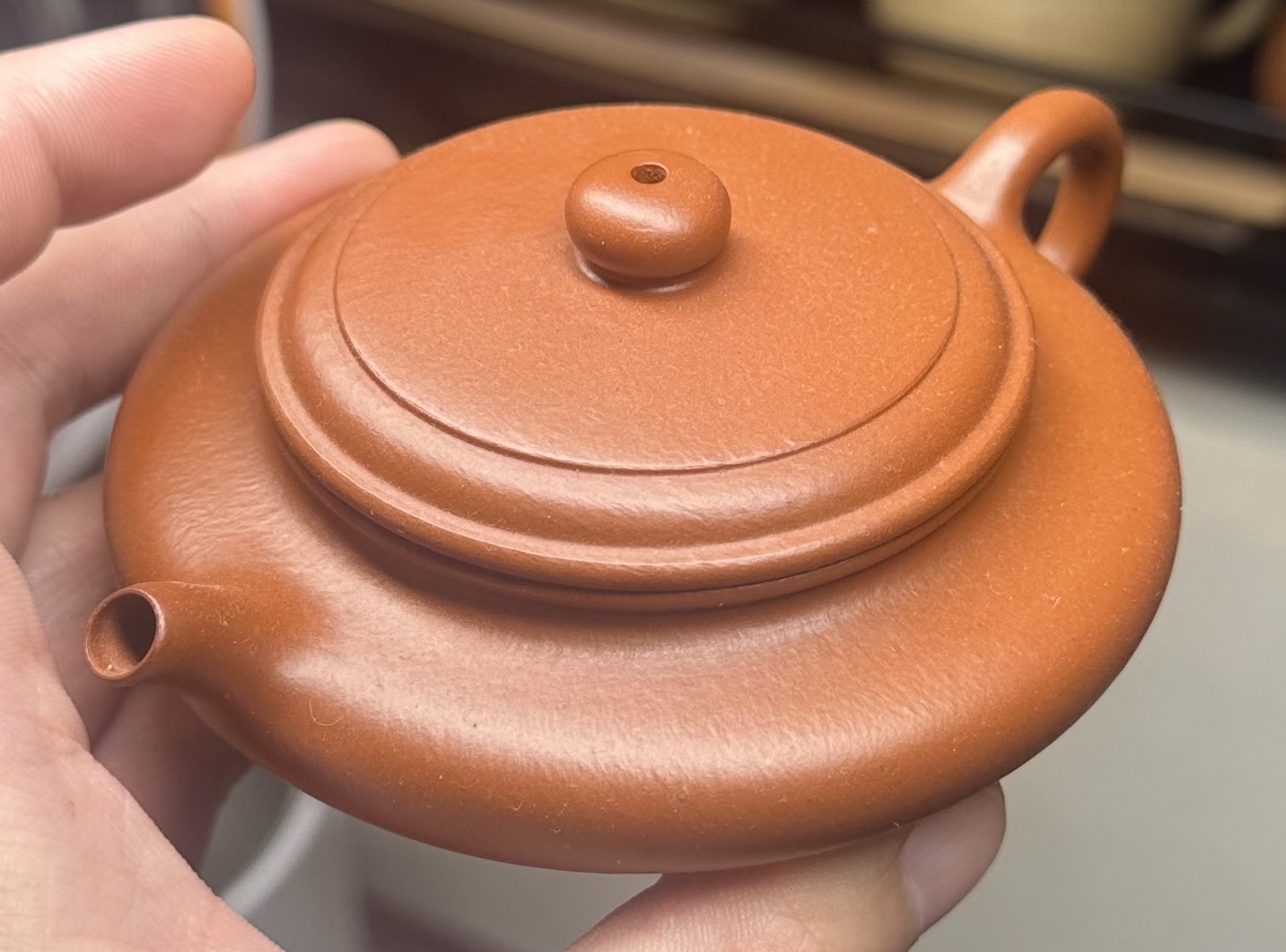
Yixing perfection, a high standard!
As yet we have not been able to characterize some real Yixing clays. Data from the SHAB test, DFAC test and SIEV test would be super interesting. And it would be even more interesting to see variation between the different Yixing types.
Our modern programmable electric kilns are a real enabler to being able to try different firing schedules, especially just about and below where bloating occurs. Also, the range of already-refined commercial materials available to use now is likely well beyond what any ancient Yixing craftsman had. Imagine if they had Veegum and deairing pugmills instead of 10 years of aging. Another key enabler we have now is detailed record-keeping software (e.g. in an account at insight-live.com) and ways to search and compare test data generated to be able to compare physical properties of multiple tests.
The obvious and authentic way would be to find an iron-bearing weathered shale (like those used in brick manufacture) and develop a way to process it to a mix of fines and coarses (the latter having a size distribution and not being too hard). Hao-Tong is in a good position here to what the working consistency should feel like, thus what direction the next test should be. The author has worked with shale and siltstone materials from Montana and one from the Niagara escarpment that might be processable. To achieve plastic strength in a non-plastic body already having the right particle size mix, an addition of bentonite and/or 200 mesh ball clay could be employed. Another strategy is to blend two or more different local materials, such as a fine silty clay with a coarser, less plastic, rewettable product. Of course, it would not be possible to achieve plasticity at the low water content levels Yixing can do.
The second option is to use the ceramic materials available from your local supplier. Using this approach, it seems wise to target the working properties as the priority, and accept whatever other firing properties they produce. Once that is achieved, one could fine-tune colour by adding stain or iron oxide. If the body turns out far too refractory, an addition of a frit, as is done with my Zero4 porcelain, would mature it.
The percentage, size distribution and nature of the coarser particles is the most difficult part. Hao-Tong is simulating them by making a low-fire grog from the very clay being used. When just slightly sintered the particles "have give" like the genuine Yixing clay. It is just a matter of experimentation to discover the right sintering temperature. Of course, a range of sieves are needed to be able to process the particulate to the right sizes.
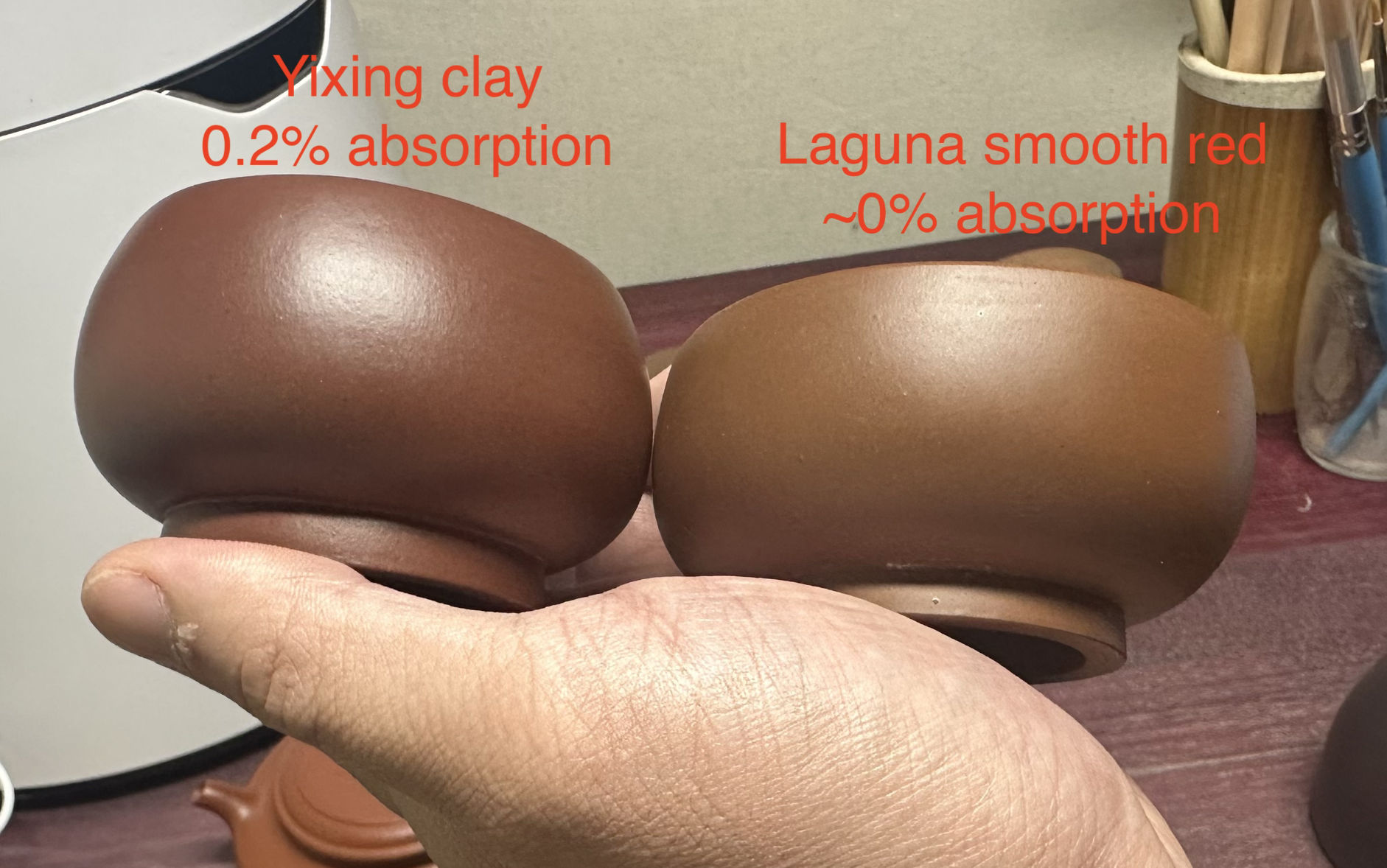
Yixing in North America!
Hao-Tong’s current testing employs various North American materials. For example: 50% Redart, 30% OM-4, 10% silica, and 10% K-spar, firing to near zero vitrification around cone 5.5.
Related Information
Yixing craftswomen at work
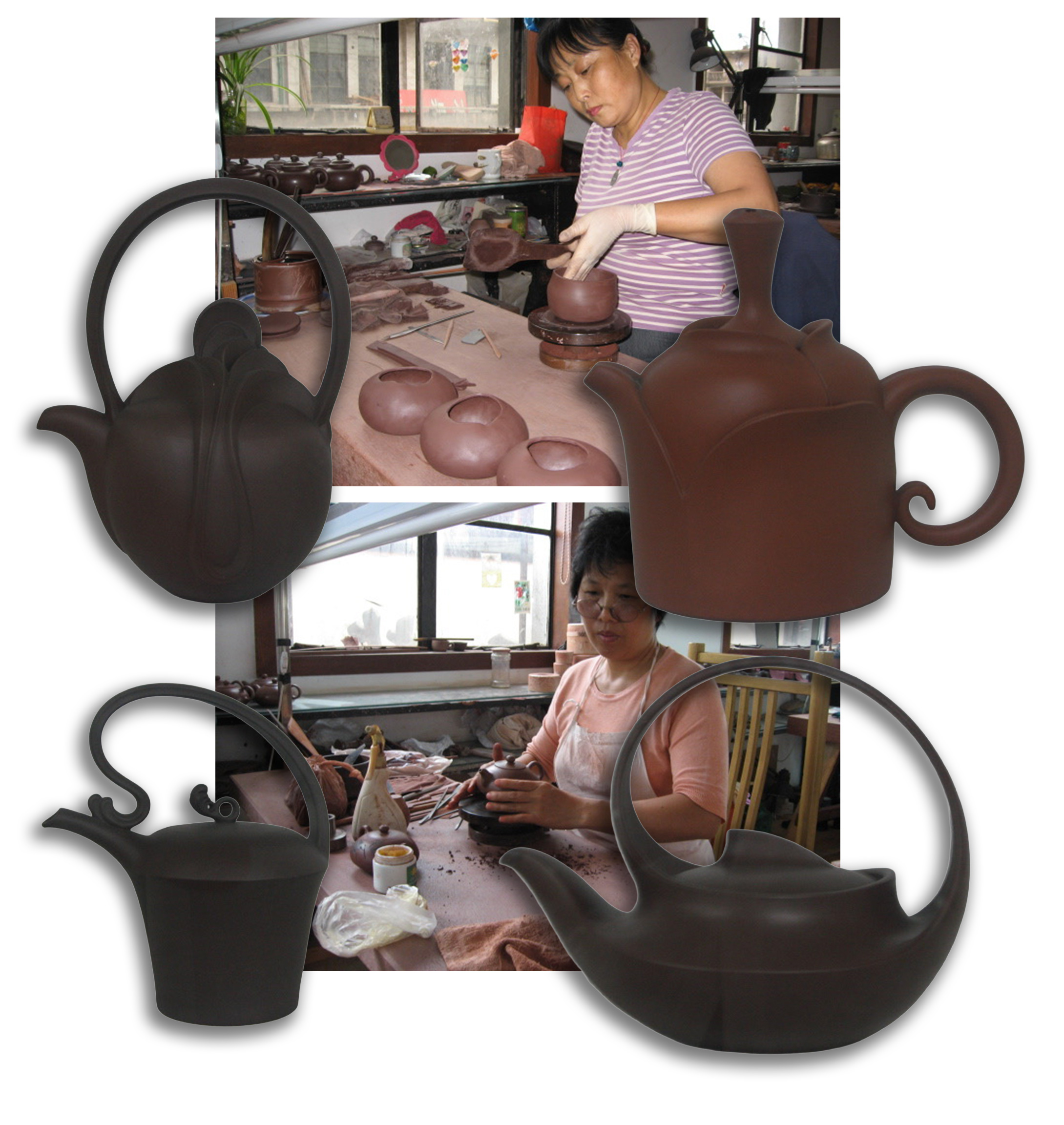
This picture has its own page with more detail, click here to see it.
The Yixing teapot craftsmen appear to break all the rules and yet produce impossibly delicate and symmetrical pieces. Hao-Tong Yan, one of those craftsmen, and I have been trying to understand the technical reasons for how this amazing craft is possible. It turns out not to be magic, but actually a highly evolved understanding of a very unusual material. Here are some of the things that we are coming to understand (which is making it possible to create a facsimile of the clay in North America).
-The clay is not highly plastic; the workability comes from surprising places.
-The clay has impossibly low water content, yet can be formed.
-Craftsmen flatten the clay with a mallet, instead of rolling it, yet it does not stick to the board.
-Sections are simply glued with slip, yet they hold.
-The clay burnishes, yet is not smooth.
-Fired ware is smooth, yet the soft clay appears sandy.
-The fired surface is glossy, yet there is no glaze.
-The fired clay appears super dense yet does have porosity.
-The Yixing ore can have the appearance of being like rocks, yet they make a workable clay body from it.
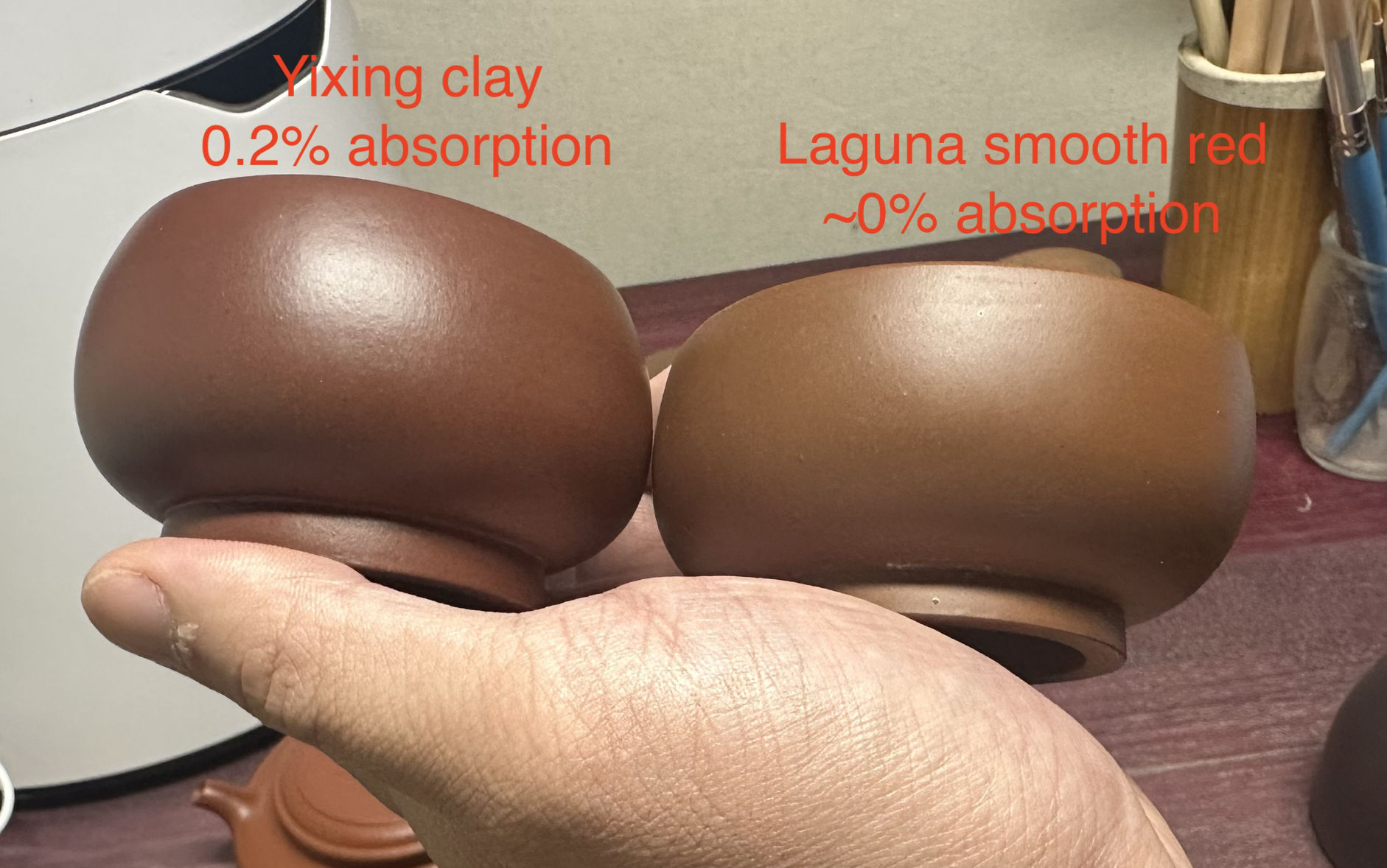
A Yixing teacup and one made here
by Hao-Tong Yan made here in the US
This picture has its own page with more detail, click here to see it.
Teacups I need to be fully vitrified, the logic being that a teacup should have less porosity because it encounters many kinds of teas and shouldn’t retain their flavors (whereas teapots are expected to be a little porous). This demand makes it even more important that they have a shape that has inherent strength to resist warping (especially given that they is not lid to hold the lip circular).
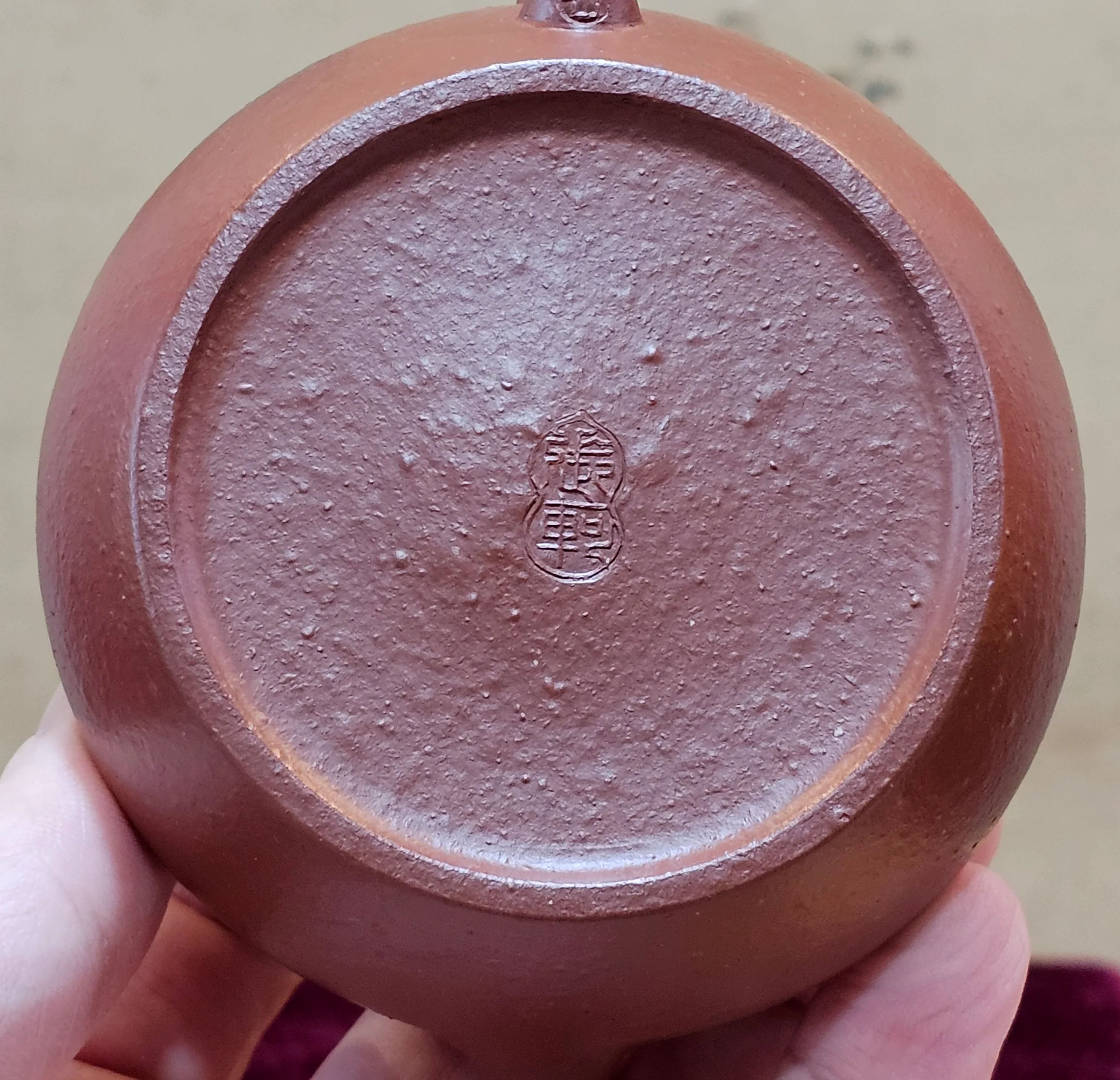
Blistering/bloating in Yixing pieces
This picture has its own page with more detail, click here to see it.
“Vitrified” can go past bloating, especially when larger impurities are present. The iron-bearing clay is being pushed to the edge. High iron clays are not like porcelain which can be fired to the density point of zero porosity, and often beyond that, without ever bloating or blistering.
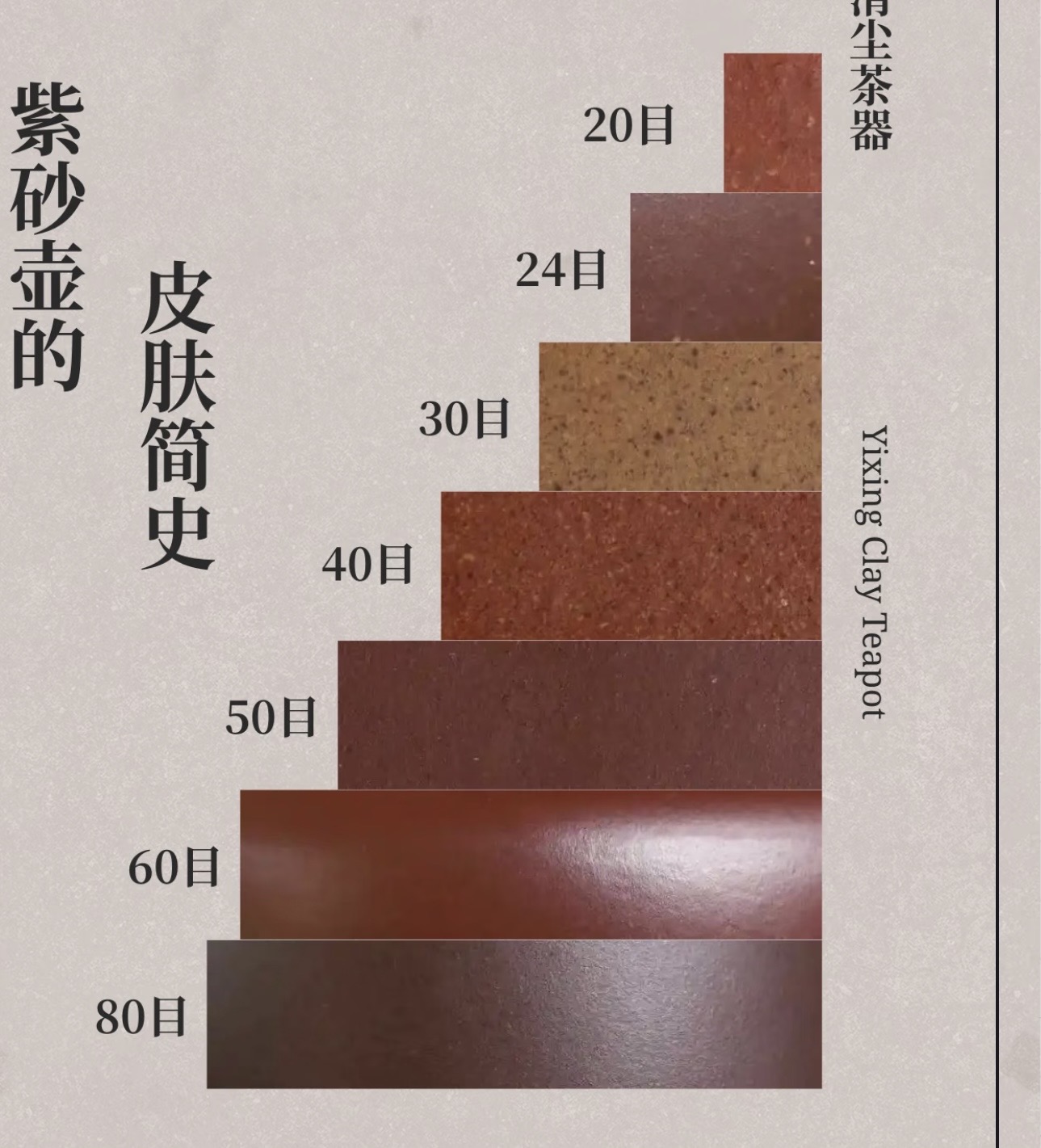
Yixing clay mesh sizes
This picture has its own page with more detail, click here to see it.
Yixing clay is quite plastic when stiff but also high in coarse clay (that is, below 80 mesh or so, and could be over 50% by weight). I was told the clay I have has somewhere between 30% and 50% of 40/50 mesh clay. The coarse clay content makes it hard to throw, because there’s so much of it, the fine clay content must actually be really plastic to allow the clay to still be workable.
These are different Yixing clays processed to different mesh sizes, the examples are to show the differences in graininess of the different mesh sizes.
Yixing clay teapots
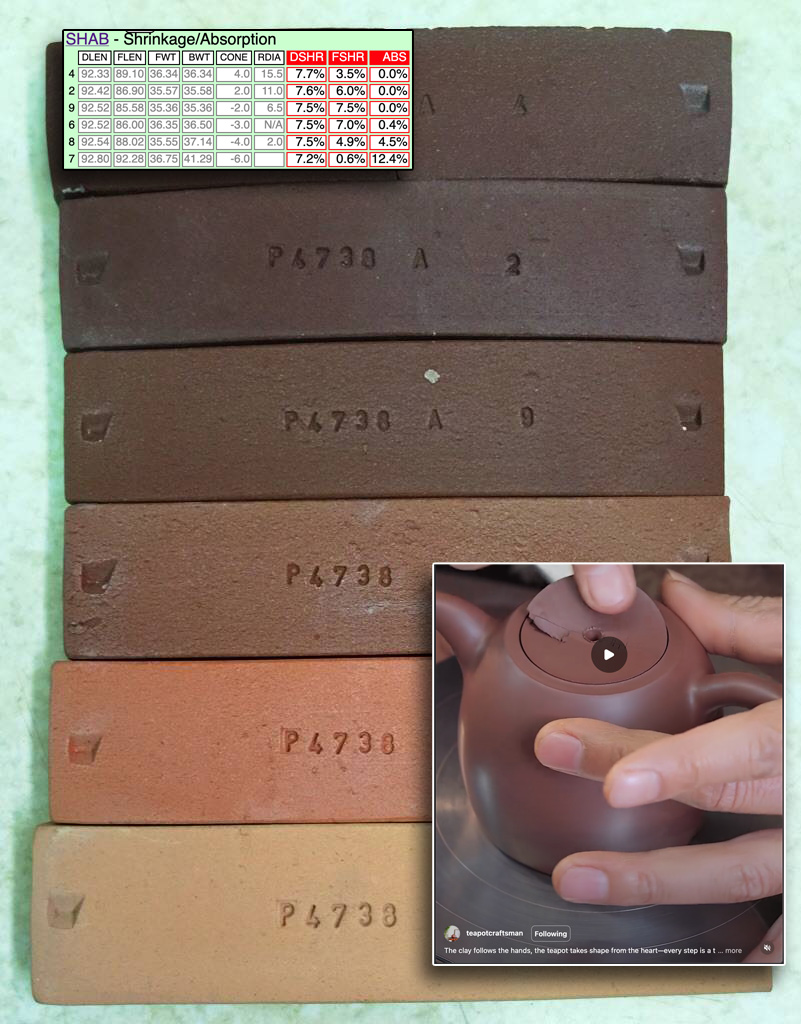
Could you make the clay?
This picture has its own page with more detail, click here to see it.
This clay is called 98BGP, it was mined in Southern Alberta in the 1990s (not for sale now). It is greenish in the wet state. Terracotta clays like this are widely available. Redart is a terracotta. This one is very smooth, but most have some grit. A potter willing to do a program of testing and record-keeping (with lots of pictures) and adapt technique to the material should be able to make this work. These fired test bars show that achieving the desired surface and density is a matter of firing temperature. The #9 bar is fired at cone 02 with 0% porosity, which is porcelain density and thus unsuitable. But the third one up is cone 03, it has 0.4% porosity. It just needs a surface enhancer to provide the sheen. Many terracotta clays have soluble salts that will ruin the appearance, but a surface enhancer will erase them.
Technicians study the physics of Yixing clay
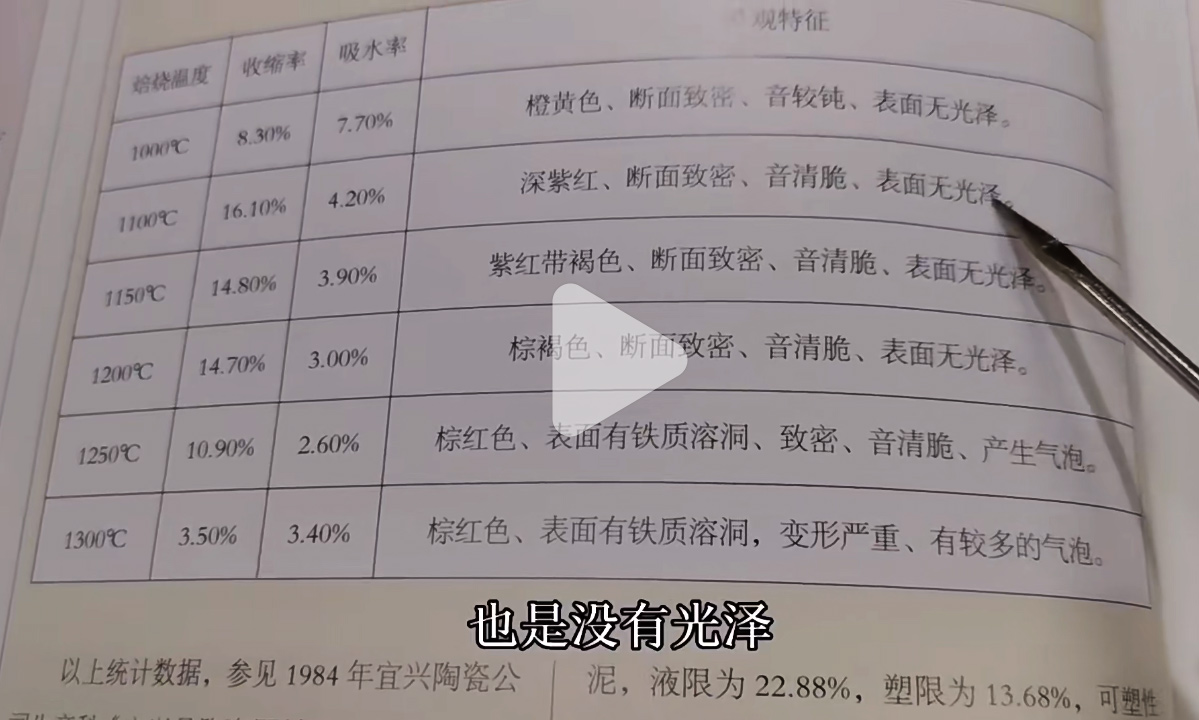
To determine the ideal firing temperature
This picture has its own page with more detail, click here to see it.
The clay here is called jiani, it’s found in various layers along with other yixing clay (but not used for teapots). The translation of this video screen capture (below), provides a fascinating insight into how they judge the suitable temperature at which to fire. First, technicians measure the porosity and firing shrinkage over a range of temperatures, likely looking for a firing "sweet spot". Notice shrinkage reaches a maximum at 1100C, then drops off as the clay begins to expand. But this is not the only thing considered. Notice, in the comments, that they are also looking for "surface luster" (which is not found). They also comment about a "dull sound" and "crisp/clear sound" (so they must create a sounding vessel of some sort). They also break a fired piece and comment of the nature of the cross section, revealing something else interesting: The clay holds on to a dense cross section for 100C degrees after reaching maximum fired shrinkage.
| Temp | Shrinkage | Porosity | Visual & Physical Characteristics |
|---|---|---|---|
| 1000°C | 8.3% | 7.7% | Orange-yellow, dense cross-section, relatively dull sound, matte surface (no luster). |
| 1100°C | 16.1% | 4.2% | Deep purplish-red, dense cross-section, crisp/clear sound, matte surface (no luster). |
| 1150°C | 14.8% | 3.9% | Purplish-red with a hint of brown, dense cross-section, crisp/clear sound, matte surface (no luster). |
| 1200°C | 14.7% | 3.0% | Brownish-red, dense cross-section, crisp/clear sound, matte surface (no luster). |
| 1250°C | 10.9% | 2.6% | Brownish-red, iron-rich melt-holes on the surface, dense, crisp/clear sound, produces bloating/bubbles. |
| 1300°C | 3.5% | 3.4% | Brownish-red, iron-rich melt-holes on the surface, severe deformation, has a relatively large amount of bloating/bubbles. |
Links
| URLs |
https://en.wikipedia.org/wiki/Yixing_ware
Yixing Clay Teapots on Wikipedia Also known as "Purple Clay Teapots" |
| URLs |
https://www.instagram.com/reel/DTkOIn5EqMv
Stunning video of Yixing teapot being meticulously handmade See how Yixing clay rolls, flattens, cuts, joins, etc. It has grit, lots of smoothing is needed. Spray bottle is used to rewet. The techniques and tools are timeless. |
| URLs |
https://www.realzisha.com/collections/new-arrivals-collection
Realzisha.com Yixing teapot videos on Instagram They teach many techniques on making teapots (in Yixing). It can be difficult to find good quality, actually fully handmade Yixing teapots online, but everything they sell is genuine. |
| URLs |
https://www.youtube.com/@ZishaCraftsman1/videos
Realzisha Yixing teapot making videos on Youtube |
| URLs |
https://www.tiktok.com/@teapotcraftsman/video/7608874743181118750
Realzisha teapot making videos on TikTok |
| URLs |
https://www.realzisha.com/
Realzisha.com Yixing Teapots |
 PayPal | No tracking, No ads, No paywall, No transient content! Just organized, concise information constantly updated and improved. Was this helpful? Consider supporting me. |
| By Tony Hansen Follow me on        |  |
Got a Question?
Buy me a coffee and we can talk 

https://digitalfire.com, All Rights Reserved
Privacy Policy