Foundry Hill Creme
Alternate Names: New Foundry Hill Creme, Foundry Hill Cream, Foundary Hill Cream
Description: Plastic clay for stoneware clay bodies
| Oxide | Analysis | Formula | Tolerance |
|---|---|---|---|
| CaO | 0.50% | 0.04 | |
| K2O | 0.70% | 0.04 | |
| MgO | 0.50% | 0.06 | |
| Na2O | 0.55% | 0.04 | |
| TiO2 | 0.50% | 0.03 | |
| Al2O3 | 20.50% | 1.00 | |
| P2O5 | 0.09% | - | |
| SiO2 | 66.20% | 5.48 | |
| Fe2O3 | 1.60% | 0.05 | |
| LOI | 8.20% | n/a | |
| SO3 | 0.09% | n/a | |
| Oxide Weight | 453.48 | ||
| Formula Weight | 494.47 | ||
Notes
Similar to a ball clay but having a much lower drying shrinkage (about 6-6.5%) and firing darker (also with a distinctly lower TiO2). Although this is a fairly refractory clay, it has a high firing shrinkage, around 8% across the entire range from cone 7 to 11. Porosity drops slowly from cone 7 upward (7% down to 4% at cone 11 oxidation and 10 reduction). Used commonly in stoneware clay bodies.
The manufacturer states: An intermediate-grained engineered blend offering excellent moisture retention and plasticity properties. Ideally suited for a wide variety of stoneware applications and wet forming processes.
Relative Viscosity (1.2 Sp. Gr.):* 1.28
Casting Rate: (gms per 15 min/426 cm2):* 209
Water of Plasticity:* 22.9
% Dry Shrinkage:* 3.94
Dry M.O.R., psi:* 239
Cone 04 8 11
----
Fired Shrinkage:* 0.2% 1.6% 1.9%
Absorption:* 20.2% 17.8% 15.2%
M.O.R. psi:* 758 2390 4630
Thermal Expansion, Cone 8: .493% at 700C
P.C.E.: 30
pH: 5.9
Oil Absorption: 28
Bulk Density, lbs per cubic foot: 37-45
Particle Size, Microns: 20 10 5 2 1 0.5 0.2
88% 73% 60% 44% 33% 21% 8%
*Specimens: De-aired, extruded, 50% ball clay, 50% flint
Related Information
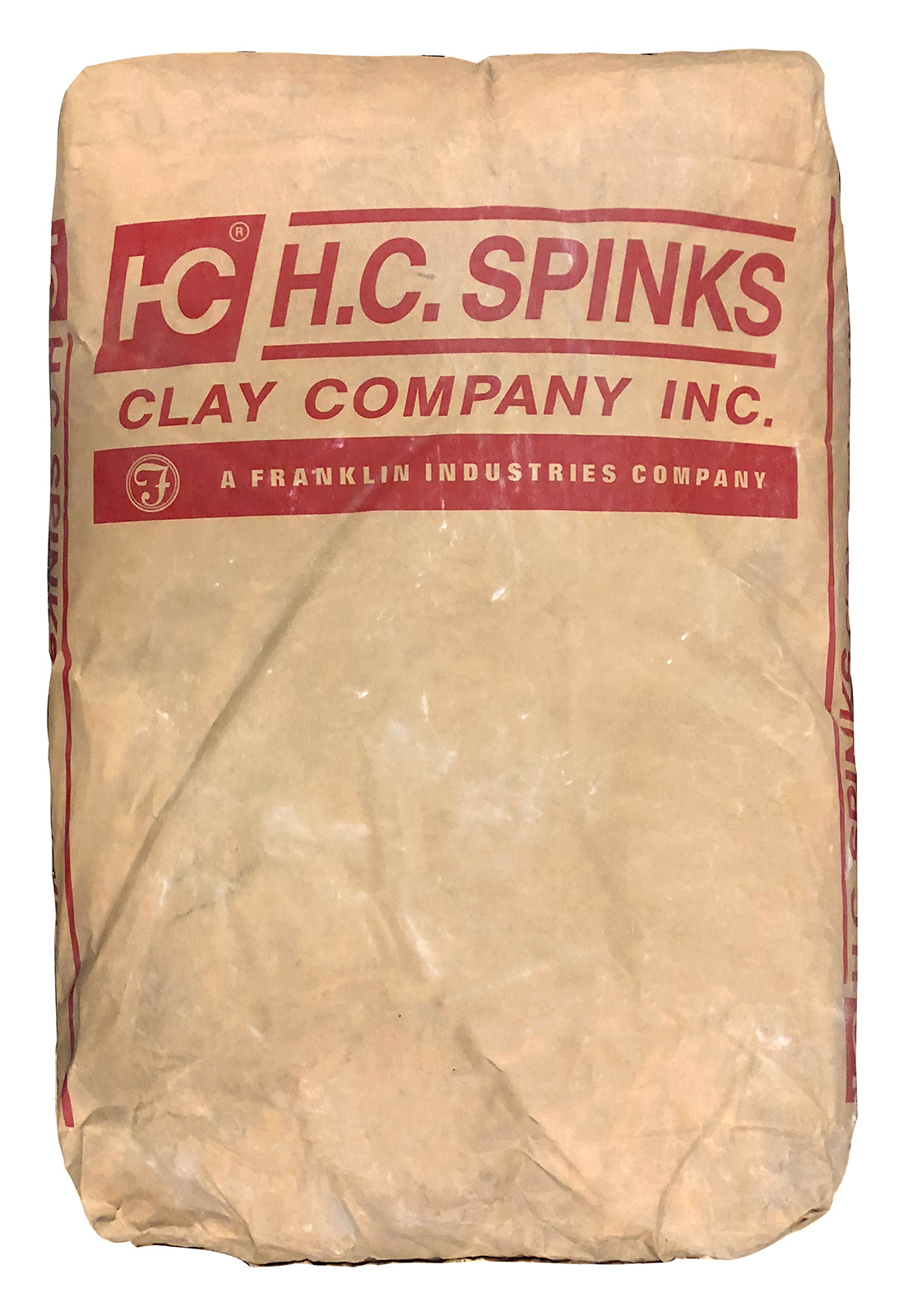
Original Container bag of Foundry Hill Cream clay
This picture has its own page with more detail, click here to see it.
Foundry Hill Creme fired test bars

This picture has its own page with more detail, click here to see it.
Top: Cone 10R (soluble salts are staining the surface). Downward: Cone 11-7 oxidation.
These look very similar to a typical ball clay, perhaps not firing quite as white.
In clay body testing, it is about the data.
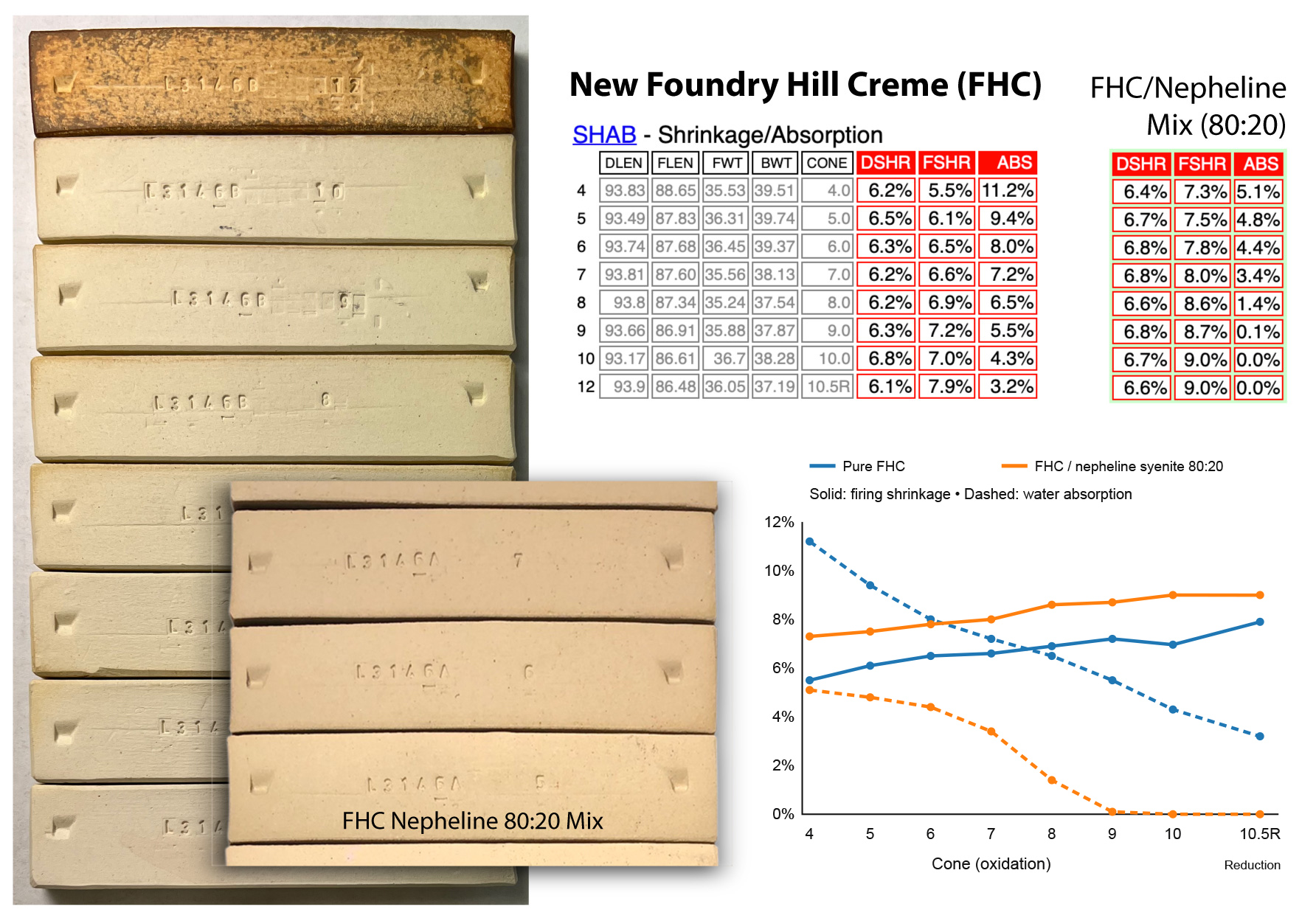
E.g. How FHC responds to a flux addition
This picture has its own page with more detail, click here to see it.
Foundry Hill Creme (FHC) is used in North America as a stoneware body base or addition. It fires like a ball clay, but it is less plastic. How much feldspar would it take to make it vitrify to zero water absorption? I code-numbered pure FHC as L3146B and fired SHAB test bars from cone 4 to 10 and 10R (note the soluble salts). The firing shrinkage and water absorption data calculate in the red columns (and plot on the blue lines). Notice the steady drop in absorption and rise in firing shrinkage, from cone 3 to 10 (and 10R). An 80% FHC and 20% nepheline syenite mix plots to the orange lines. Notice cone 9: The absorption hits zero while the firing shrinkage is a steady 1.5-2% more than pure FHC. The drying shrinkage of the two can also be compared. It takes a 35% nepheline addition to most ball clays I have tested to achieve near-zero absorption; it appears this is going to need the same. This kind of data is what enables recipes to be created.
Links
| Typecodes |
Clay Other
Clays that are not kaolins, ball clays or bentonites. For example, stoneware clays are mixtures of all of the above plus quartz, feldspar, mica and other minerals. There are also many clays that have high plasticity like bentonite but are much different mineralogically. |
| Materials |
Gleason Ball Clay
|
Data
| Pyrometric Cone Equivalent | 31 |
|---|
 PayPal | No tracking, No ads, No paywall, No transient content! Just organized, concise information constantly updated and improved. Was this helpful? Consider supporting me. |
| By Tony Hansen Follow me on        |  |
Got a Question?
Buy me a coffee and we can talk 

https://digitalfire.com, All Rights Reserved
Privacy Policy