Notes
The North American standard for making molds for ceramics for decades.
USG is closing/mothballing its Southard, Oklahoma mine and manufacturing plant in November 2026, after more than a century of operation. USG attributes the decision to rising costs and operational complexity. More than 250 jobs are affected
Related Information
The Great Plaster Squeeze - 2026
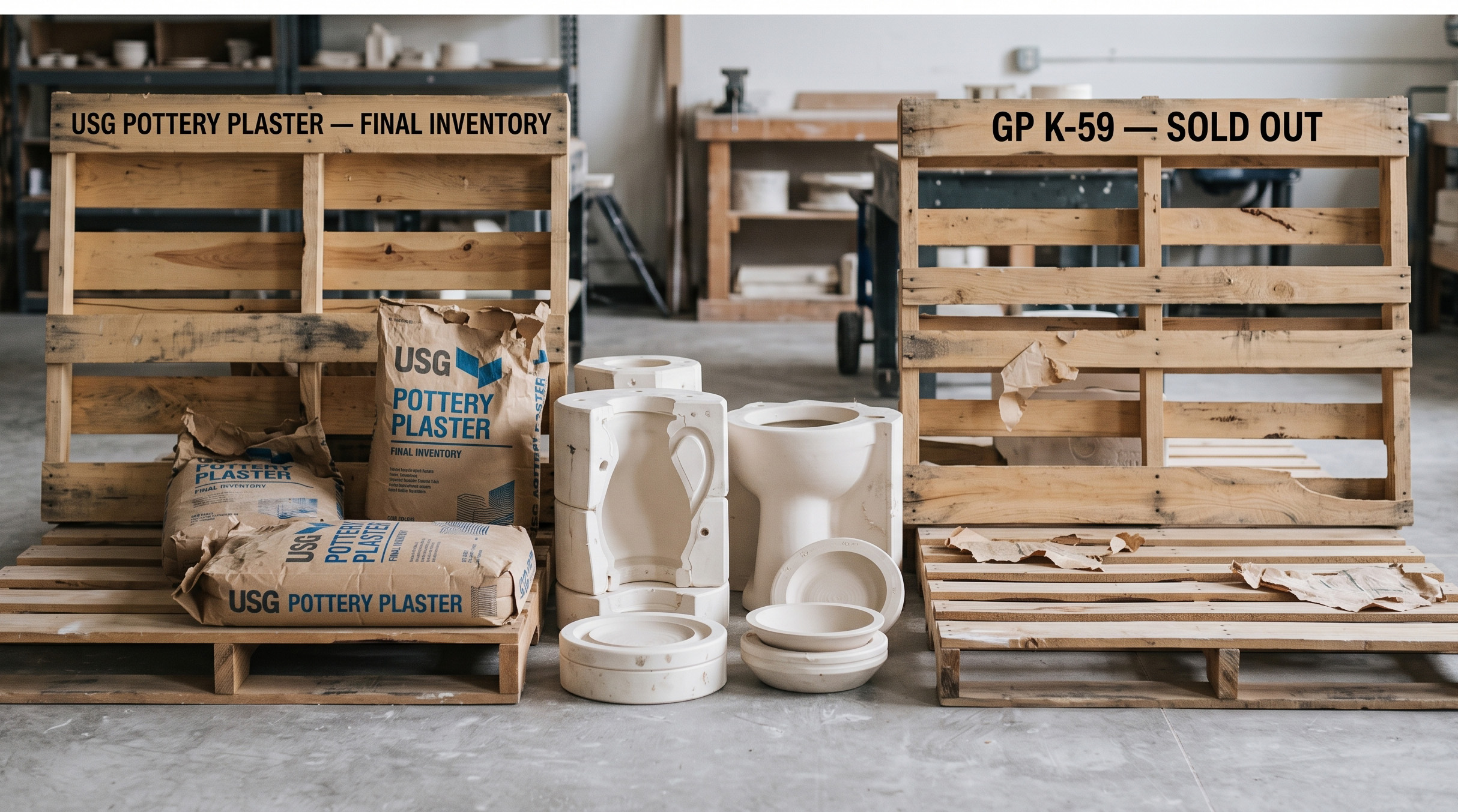 Create at Gemini by a submission of the text from this post.
This picture has its own page with more detail, click here to see it.
USG specialty plaster is entering a final-inventory phase in the ceramic supply chain, and rationing has begun at some suppliers even though the Southard plant does not close until November.
Aug 19: News from Australia
An Australian industrial supplier now states that USG is “phasing out its entire Industrial Products range” made at Southard, that USG has confirmed these products will not be manufactured at another site, and that USG is no longer accepting orders.Aug 29: One supplier is imposing anti-hoarding restrictions:
It will serve normal requirements of existing customers, but will not sell plaster to new customers or permit purchases substantially above usual volumes. It is investigating alternative sources. Another is now limiting Hydro-Stone purchases to 100 lb per customer per week.
USG and CGC themselves still have active product pages for No. 1 Pottery Plaster, Hydro-Stone and Ultracal 30, with no visible discontinuation notice, so their public website continues to lag what distributors are reporting.Aug 31: GP K-59 sold out at some suppliers
Several Canadian suppliers are already showing Georgia-Pacific K-59 as sold out. Another still has 10 of K-59 available, compared with 172 bags of USG No. 1 Pottery Plaster still in stock. That suggests demand may already be shifting toward K-59 faster than some distributors can replenish it.
A signal from Georgia-Pacific itself: Its Blue Rapids, Kansas Industrial Plasters facility, the plant historically associated with K-59, is actively hiring maintenance personnel, including for a rotating 12-hour schedule, with the job posting emphasizing equipment reliability, production optimization and operating performance. Georgia-Pacific’s official industrial-plaster site continues to present pottery plaster as a core business and says it supplies sanitaryware and dinnerware manufacturers and produces both alpha- and beta-gypsum plasters. I still find no announcement of a production increase, additional shifts, capacity expansion, new warehouses, or a specific commitment to replace USG’s Southard volume.Sept 1: A distributor is out of USG products
It reports that it is completely out of USG No. 1 Pottery Plaster, Hydro-Stone and 20 Minute Casting Plaster, with only a limited amount of Hydrocal White remaining.Sept 2: GP announces close of a plant
Georgia-Pacific officially announced that it will permanently close its Tacoma, Washington gypsum plant, affecting 125 employees. GP says weak repair/remodel demand is the reason, and importantly says it expects to continue satisfying customer demand from its remaining facilities. The Tacoma operation is a gypsum-board plant, not the Blue Rapids industrial-plaster operation associated with K-59, so this does not indicate that K-59 production is being cut. But it does show GP is actively rationalizing its gypsum manufacturing network rather than broadly expanding it at this moment.Sept 6: USG online store has an “LIMITED INVENTORY” notice
It states that availability of USG plasters and gypsum cements is limited and that once a product sells out, it will no longer be available and will be discontinued. Interestingly, significant final inventory remains: 312 bags of No. 1 Pottery Plaster, 218 Hydro-Stone, 123 Ultracal 30 and 95 Hydrocal White, all in 47.5-lb bags. These are being offered for sale while supplies last. The main USG website and CGC pages still have ordinary-looking product listings for No. 1 Pottery Plaster, Cerami-Cal and other products, without conspicuous discontinuation notices.Sept 9: Various distributors have no K-59 in stock
The persistent K-59 shortages at ceramic suppliers suggest that distribution or production is not yet keeping pace with the emerging ceramic-market shift.The demise of USG plasters!
If true, this is seismic for ceramics.
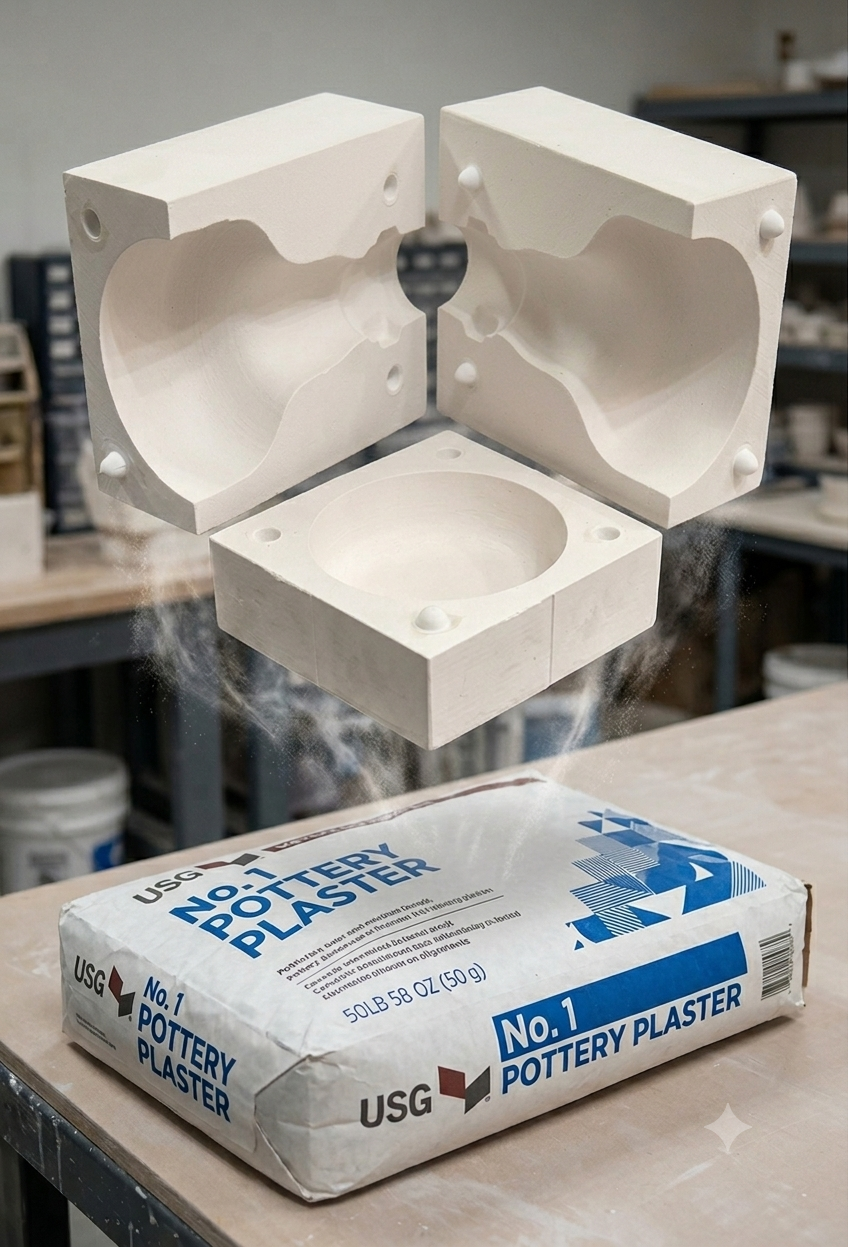
This picture has its own page with more detail, click here to see it.
The ceramic industry depends on some surprisingly specialized materials made by very few companies. When one of those companies exits the market, we need to notice. Consider how much of ceramics depends on plaster: slip casting of pottery and sanitaryware, jiggering, RAM pressing, mold making and countless studio processes. Yet plaster is so inexpensive and familiar that we tend to forget how technologically specialized—and indispensable—it actually is. USG #1 Pottery Plaster has been an industry standard for generations.
July 30, 2026: The Bad News
USG is closing its historic Southard, Oklahoma gypsum operation, apparently ending production of a wide range or specialty plasters including #1 Pottery Plaster, Hydro-Stone, Ultracal, Hydrocal, Puritan. This is a potentially seismic event for ceramics.There is Hope
The core mineral in wallboard and pottery plaster is calcium sulfate hemihydrate. Historically, some gypsum plants produced both wallboard stucco and pottery plaster from the same gypsum source, separating the streams after calcination and tailoring each to its intended application. So maybe USG could make No. 1 Pottery Plaster at one of its wallboard plants. Unless there is something unique about the Southard process or the raw gypsum or reports of them "ceasing all industrial plaster operations" are accurate.There is an Alternative
Fortunately, there is another major North American producer: Georgia-Pacific. Its K-59 Pottery Plaster is a remarkably close counterpart to USG #1, having essentially the same normal water/plaster ratio and density, with similar strength and expansion. Without products like these from Georgia-Pacific, the USG withdrawal could have been a genuine supply-chain earthquake for ceramics. Instead, it should be a wake-up call.Cautious Optimism
Georgia-Pacific has a long-established Industrial Plasters division with dedicated sales managers covering both the U.S. and Canada. GP already manufacture pottery and tooling plasters, ceramics is one of the industries they explicitly target. If they decide to embrace the opportunity, they would become the primary North American supplier of specialty ceramic plasters. The biggest uncertainty is whether they can produce enough to replace what USG has historically supplied. And whether ceramic suppliers will begin stocking much larger inventories.

PayPal | No tracking, No ads, No paywall, No transient content!
Just organized, concise information constantly updated and improved.
Was this helpful? Consider supporting me. |
|
By Tony Hansen
Follow me on
       |  |
Got a Question?
Buy me a coffee and we can talk 

https://digitalfire.com, All Rights Reserved
Privacy Policy