Search Results - URLs
Gillespie Borate fact sheet from Hammill and Gillespie.: https://digitalfire.com/4sight/datasheets/GillespieBorateFactSheet.pdf
Search Results - Materials
Search Results - Pictures
-
Tap picture for full size and resolution
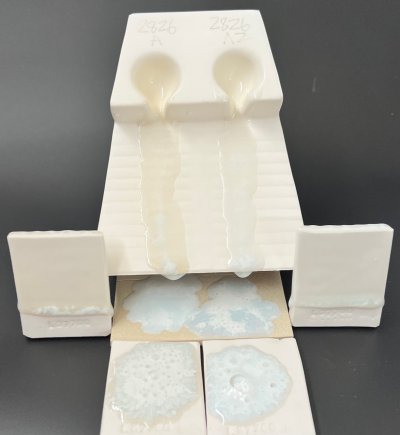 Gerstley Borate 50:30:20 glaze using Gillespie Borate instead
This is the G2826A 50:30:20 GB:kaolin:silica base clear recipe. It is been used for decades as a base for all kinds of glazes. It starts melting early enough for use on low-temperature earthenware and is widely used in the raku process. Yet it is also common at middle temperatures (obviously care must be taken or it will run off ware onto kiln shelves when fired to cone 5-6). These tests were fired to cone 6 using the PLC6DS schedule. The samples on the left use Gerstley Borate, on the right Gillespie Borate. The GBMF test tiles (lower left and right) reveal how much off-gassing is still happening on both when melting starts (they are full of bubbles). The GLFL test (centre) shows the melt flow of the two glazes, it is very similar (normal glazes do not run off the end of the runway like this). The two porcelain test tiles show it to fire crystal clear (there is some pooling since these were applied too thick). There is thus good reason to believe that Gillespie Borate will work well in this class of recipes. …
-
Tap picture for full size and resolution
 Gerstley Borate vs. Gillespie Borate at 1550F (840C)
The GLFL test ball of pure Gerstley Borate has shrunk and vitrified to a porcelain state here at 1550F (the ball is half the original size and gets even smaller by 1600F). Not surprisingly, Gerstley Borate has a significant LOI; it finishes off-gassing at about 1400F, which enables the high shrinkage that occurs between 1350 and 1600F. Gillespie Borate, on the other hand, is obviously here experiencing an overlap between the gassing and melting phases (it is already melting while gases of decomposition are being expelled). That means that glazes having a high percentage of it are going to do this as they are heated through this range in a firing. It was not clear at first how this might affect glazes but it became evident later: Crawling and spitting. …
-
Tap picture for full size and resolution
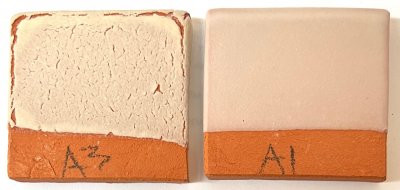 Gillespie Borate is doing something very strange at 1700F
On the left is G2826A3, a cone 6 transparent glaze (an improvement on the 50:30:20 classic Gerstley Borate base transparent recipe, substituting Gillespie Borate, reducing its percentage and increasing SiO2). Despite the improvements it exhibits this strange cracking and crawling. The G2826A1 on the right uses a frit to source the boron instead, clearly a better idea. These tiles were fired to 1700F. The problem is likely the ulexite mineral in the Gillespie Borate - it is known for this behavior of suddenly shrinking and then suddenly melting (the latter of which is just starting). Since Gillespie Borate is plastic and suspends slurries well, I thought calcined kaolin would be better than raw kaolin in the G2826A3 recipe (to minimize drying shrinkage). However, it did not improve the situation. All of this being said, this recipe is still working reasonably well at cone 6 (stopping and holding it at 1700F may exaggerate the problem). …
-
Tap picture for full size and resolution
 Here is why Gillespie Borate crawls some glazes
This is a variation on the 50:30:20 cone 6 very fluid-melt pottery glaze recipe. I reduced the Gillespie Borate (GB) to 37% instead of the original 50% (thus bringing the B2O3 from 0.63 down to 0.5). My objective was to reduce the melt fluidity. But the crawling was so bad in this that it is almost unusable. The reason was not obvious until I fired a sample to 1550F and 1650F. At the former, the integrity of the glaze layer is great, but by 1650F it melts suddenly and does this. It is not difficult to see why these “puzzle pieces” with curled up edges might pull inward to create "glaze islands" characteristic of glaze crawling. This is happening even though the percentage of Gillespie Borate is lower. Not surprisingly, Ulexite mineral, which GB almost certainly contains, is also known for suddenly shrinking and melting. I tried to solve another problem at the same time. GB is plastic on its own, and thus hardens the layer and suspends slurries well. Thus, the 15% kaolin in the recipe unnecessarily increases the drying shrinkage. So I substituted calcined kaolin. While it helped with that problem that was small consolation. …
-
Tap picture for full size and resolution
 The original Floating Blue recipe:
Comparing Gerstley and Gillespie Borates
The original Floating Blue recipe:
Comparing Gerstley and Gillespie Borates
The original Floating Blue recipe, our code number G2826R, has been popular for 50 years. But also troublesome (because of a fragile mechanism, poor slurry properties and inconsistencies in Gerstley Borate and rutile). Gillespie Borate, it's 2023 apparent successor, appears to solve most of its issues. These specimens of the recipe were fired using the cone 6 C6DHSC schedule. We have "vintage" Gerstley Borate from the 1990s, that is what was used here. Top left: Floating Blue using Gerstley Borate (GB) (top) and Gillespie Borate bottom on a buff burning body. Top right: Same but on a red burning body. Centre: Melt fluidity GLFL test of the two glazes (GB) on the left. Bottom: The two recipes and their calculated chemistries. Clearly, the Floating Blue itself is firing greener than usual. And the Gillespie Borate version is much bluer. You may be used to something in between these two. The green tones could likely be restored by a reduction in the cobalt and increase in the iron oxide. The best news is that at 1.47 specific gravity, Gillespie Borate produces a far better slurry, there is no gelling. And no sign of settling into a hard layer. The chemistry comparison at the bottom highlights some concerns, the difference is not insignificant. B2O3, Al2O3 and SiO2 are all lower (this could be part of the reason for the differences in color also). For better or worse, the melt fluidity is the same: Very high. This is likely because the percentage of Ulexite is higher (that melts better than Colemanite). …
-
Tap picture for full size and resolution
 The popular Gerstley Borate 50:30:20 glaze:
Is the Gillespie Borate version any better?
The popular Gerstley Borate 50:30:20 glaze:
Is the Gillespie Borate version any better?
This recipe, G2826A, a base transparent recipe having 50% Gerstley Borate plus 20% kaolin, was used by generations of potters; it melted so well, yet without any frit. But, it was "jelly city". Although a low temperature base, this was much more commonly used at cone 5-6. This recipe, G2826A, was at the limit of the slurry properties that could be tolerated with this material. In this test, even with 2.5g of Darvan deflocculant in this jar, it was still thick enough to require pushing this tile down into it! It still needed 5 seconds to build up enough thickness. And did not cover the recesses properly. Yet people used this popular fluid-melt to get the surface variegation its high melt fluidity produced (because it was so high in boron). They added all manner of colorants and opacifiers and it generally performed without blistering. This was a "Dr. Jekyll and Mr. Hyde" of ceramic materials! Potters are using Gillespie Borate in this recipe (with issues), see the G2826A2 recipe. Other approaches are to source the boron (B2O3) from a frit (or mix of frits). An example is G2826A1, it does not variegate as much, but adding titanium or rutile can emulate that. Another hybrid option is the G2826A3 that employs both Gillespie Borate, nepheline and talc. …
-
Tap picture for full size and resolution
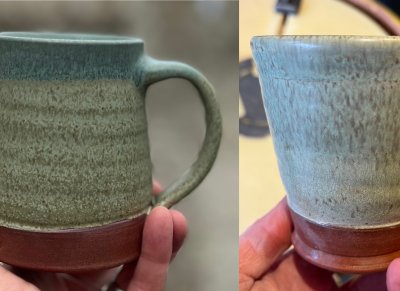 This glaze is not working with Gillespie Borate. What to do?
These two mugs employ the same cone 6 pottery glaze recipe, the high-feldspar calcia matte (Ovo Perfect Matte). Like other mattes, it is high in calcium carbonate/wollastonite and kaolin but has no silica. But the one on the left has 13% Gerstley Borate while the one on the right uses Gillespie Borate. Gerstley Borate is a complex material, one that Mother Nature has uniquely endowed. It is a brown powder, a mix of two calcium borate minerals, ulexite and colemanite. And it is plastic, very plastic, from a hyper-fine particled clay (likely hectorite). And trace minerals. Gillespie Borate, by contrast, is a white powder, a synthetic blend attempting to replicate the obvious melting and physical properties of Gerstley Borate. It has, what some call, "a cleaner chemistry", enabling it to enhance rather than muddy whatever colorants are present. Any borate can melt well and foster crystallization, but Gerstley Borate is a mix of two borates that have different melting temperatures and patterns, this encourages phase separation and thus variegation in the aesthetic (its sub-micron clay particles may also act as catalysts). What could be done? Add some iron to dirty up the material; if well dispersed in the slurry, 0.25% added to the recipe, might be sufficient. While Gillespie also has MgO, it might not be in the same form. A 1-2% addition of magnesium carbonate could help. And a small percentage of hectorite would provide some super-fine particles (with MgO). …


Got a Question?
Buy me a coffee and we can talk 

https://digitalfire.com, All Rights Reserved
Privacy Policy