Search Results - Glossary
Ceramic stains are manufactured powders. They are used as an alternative to employing metal oxide powders and have many advantages.
Search Results - Stores
- Industrial Minerals Company, Sacramento CA
Search Results - Pictures
-
Tap picture for full size and resolution
 1215U clear glaze with various Mason stains
G1215U is a recipe having a significant amount of the super low expansion Ferro frit 3279. The result is an ultra-clear glaze that will fit pretty well any clay body without crazing. The mechanism is a high level of MgO, that means it responds differently to stains. …
-
Tap picture for full size and resolution
 G1214M, W, N, O and S with Mason stains
This shows clearly how well the M version works with a chrome-tin stain compared to the others. However the 6100 brown stain works best in the N recipe (which have MgO). Notice also that the M has a higher thermal expansion than the others. …
-
Tap picture for full size and resolution
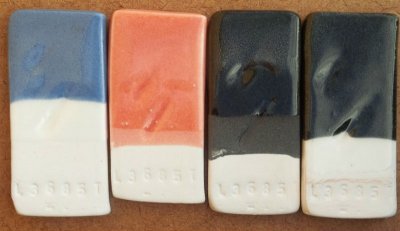 L3685T-based engobes with 5% Mason stains added
Each has been over-glazed using 1916J transparent and fired at cone 03. Micro-bubbles in the glaze is a problem. …
-
Tap picture for full size and resolution
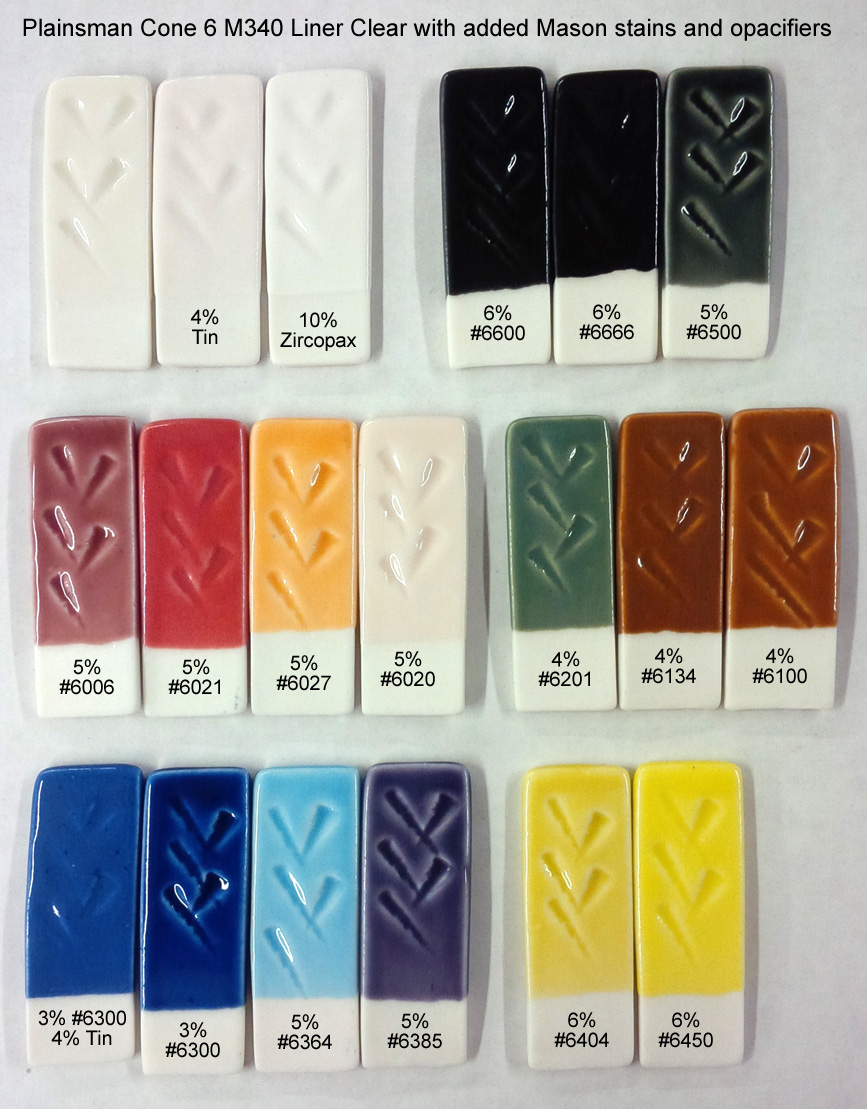
 M340 Transparent base glaze with Mason stains
M340 Transparent Liner glaze fired at slightly lower than cone 6. Using these modest stain amounts the degree of melting of the glaze is not overly affected (these were balls, they flattened during firing). However as a glaze layer on a body, many of these will not be as dark as you see here. …
-
Tap picture for full size and resolution
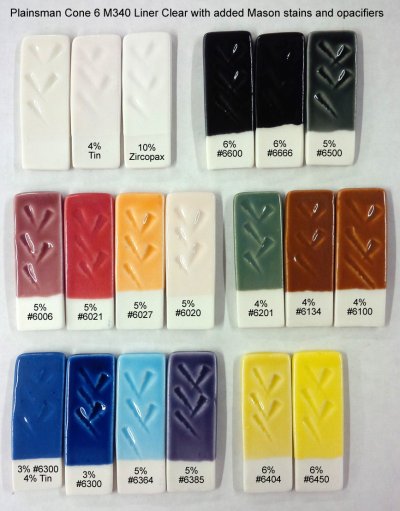 Mason stains in G2916F cone 6 clear base
These are Mason stains added to cone 6 G2916F clear liner base glaze. Notice that all of these stains develop the correct colors with this base (except for manganese alumina pink 6020). However caution is required with inclusion stains (like #6021), if they are rated to cone 8 they may already begin bubbling at cone 6 is some host glazes. …
-
Tap picture for full size and resolution
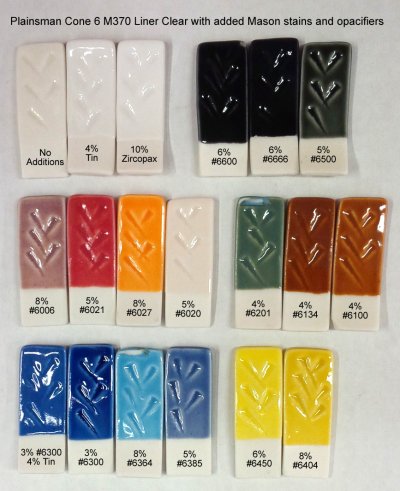 Mason stains in the G2926B base glaze at cone 6
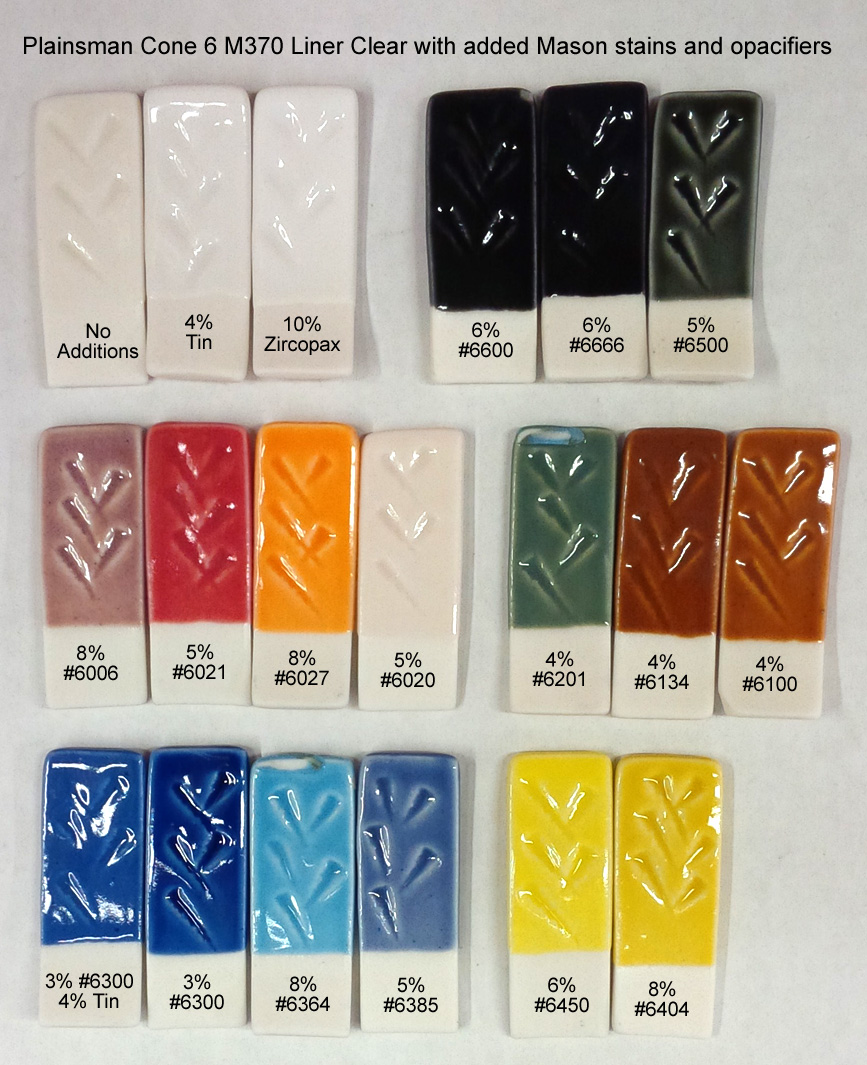
This glaze, G2926B, is our main glossy base recipe. Stains are a much better choice for coloring it than raw metal oxides. Other than the great colors they produce here, there are a number of things worth noticing. -Stains are potent; the percentages needed are normally much less than for metal oxides. -Staining a transparent glaze produces a transparent color, it is more intense where the laydown is thicker - this is often desirable in highlighting contours and designs. For pastel shades, add an opacifier (e.g. 5-10% Zircopax, more stain might be needed to maintain the color intensity). -The chrome-tin maroon 6006 does not develop well in this base (alternatives are G2916F or G1214M). -The 6020 manganese alumina pink is also not developing here (it is a body stain). -Caution is required with inclusion stains (like #6021). Bubbling, as is happening here, is common - this can be mitigated by adding 1-2% Zircopax. -And it’s easy to turn any of these into brushing glazes or dipping glazes. Be sure to blender mix them to break up any agglomerates. …
-
Tap picture for full size and resolution
 Mason stains in the G2934 matte base glaze at cone 6
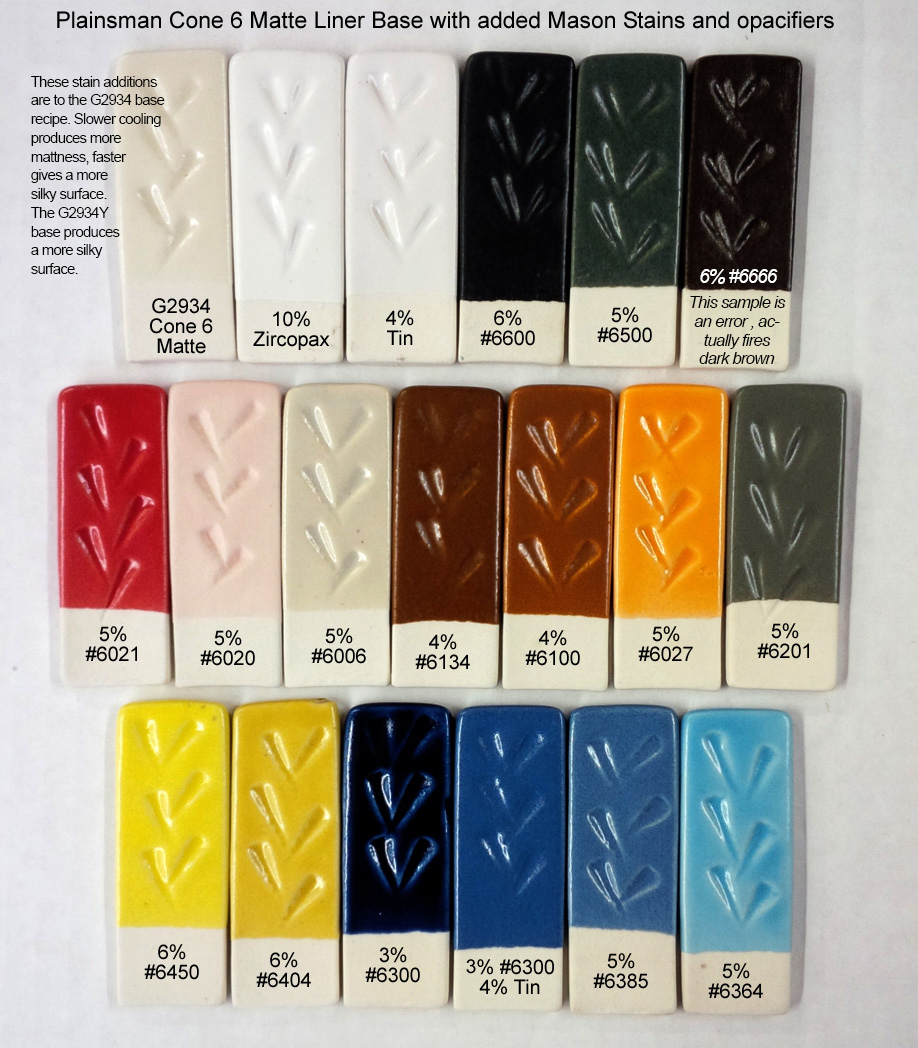
Stains can work surprisingly well in matte base glazes like the DIY G2934 recipe. The glass is less transparent and so varying thicknesses do not produce as much variation in tint as glossy bases do. Notice how low many of the stain percentages are here, yet most of the colors are bright. We tested 6600, 6350, 6300, 6021 and 6404 overnight in lemon juice, they all passed leach-free. The 6385 is an error, it should be purple (that being said, do not use it, it is ugly in this base). And chrome-tin pink and maroon stains do not develop the color (e.g. 6006). But our G1214Z1 CaO-matte comes to the rescue, it both works better with some stains and has a more crystal matte surface. The degree-of-matteness of both can be tuned by cooling speed and blending in some G2926B glossy base. You can mix any of these into brushing or dipping glazes. Be sure to blender mix them to break up any agglomerates. …


Got a Question?
Buy me a coffee and we can talk 

https://digitalfire.com, All Rights Reserved
Privacy Policy